The Metaknight of the Doleful Countenance
The postmodernists have nothing on Don Quixote.
Rob James
May 20, 2026
I have had a Folio Society edition of Don Quixote by Miguel de Cervantes Saavedra sitting on my shelf for years. I admired the whimsical line drawings of Quentin Blake but was put off by the small-print reproduction of the eighteenth-century translation by Tobias Smollett (author of Peregrine Pickle, Humphry Clinker and Roderick Random). I was delighted when visiting the Falmouth Memorial Library here in Maine I recently came across a graphic-novel treatment by Rob Davis. With both versions in hand, I finally explored what all the fuss is about, why Don Quixote is considered “the best novel of all time” and “a central work in world literature.” Or whether it is worth all the fuss.
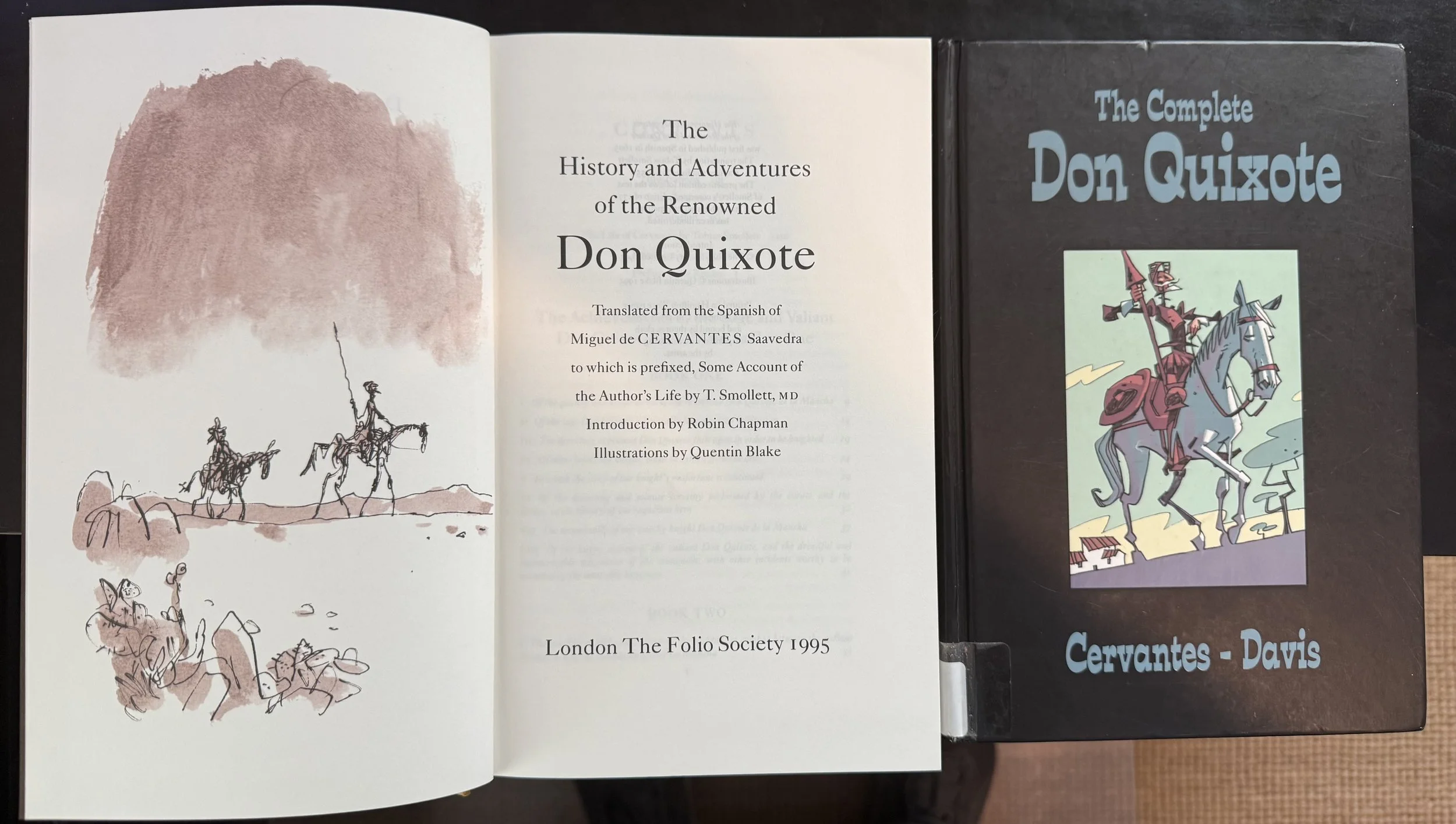
You have been living under a rock if you don’t know the basics of the story. A fifty-ish-year-old gentleman, Alonso Quijano, living with his niece, housekeeper and servant in a nondescript part of La Mancha (apparently not as romantic a locale as other parts of Spain), has gone wacko bonkers reading books about knights in shining armor and picaresque tales of adventures. Think Apuleius’s The Golden Ass, Amadis the Gaul, Tirant lo Blanch, and the two Orlandos (Furioso and Innamorato). He conceives of himself as Don Quixote de la Mancha, his swayback horse the noble steed Rocinante, and his lady the pork-vendor Dulcinea del Toboso. He soon recruits the earthy shepherd Sancho Panza as his squire, promising him the governorship of an island some day. Sancho apostrophized his master as the “Knight of the Doleful Countenance,” but the master proclaimed himself “Knight of the Lions.”
The duo sets off in the iconic fashion shown on the Folio Society’s frontispiece. He is “knighted” by a barkeep in the presence of ladies of ill repute; he does battle with and is upended by a host of giants who turn out to be windmills; he attacks an army that turns out to be sheep. He gallantly frees a boy being whipped and prisoners being taken to the galleys, with comical and adverse results. One disaster after another is caused by the delusions of the addled romantic, leaving chaos. laughter and a surprising amount of mayhem and bloodshed in his wake.
The first volume was published in 1605 to great acclaim. Someone published an unauthorized sequel, and in 1615 Cervantes published the second volume.
There more confusion reigns, culminating in the Duke and Duchess taking the duo into their confidence for their amusement. The Duke grants Sancho his coveted governorship—of an entire island—in consideration of Sancho’s whipping his own buttocks. Alas, it is a “landlocked isle,” Barataria. Sancho being an island governor is a bit like being an Admiral in the Nebraska Navy. (As a little boy I was confused by The Sound of Music’s Captain Von Trapp being in the Austrian Navy, not yet knowing Austria used to extend rather farther and wetter than its postwar boundaries.) He is illiterate so served by a condescending staff that (at least in the graphic novel) has him sign letters with “IDIOT” splayed across his coat of arms. They ride through a town with “Fool” and “The Fool who Follows the Fool” affixed to their backsides akin to a junior-high school “KICK ME” prank.
By the end, Don Quixote and Sancho Panza return home to La Mancha, where the knight fell into a six-day sleep then awoke sane. He renounced his delusions, made a will to his niece disinheriting her if her husband were to read a book of chivalry, and departed this vale of tears after the administration of holy last rites.
None of this is really my cup of tea, it’s too long for the return on the jokes. What I did enjoy were the metanarrative touches. A seventeenth-century work, coeval with Shakespeare, has features that remind me of twentieth-century postmodernism.
First, Cervantes claims that this story was written in Arabic by “Cide Hamete Benengeli,” and that he purchased the manuscript and had it transcribed by a Moor. So we are in a story inside a story from almost the beginning through to the very end.
Second, the narrative is interrupted by all manner of stories told by the knight or by those he encounters. We put aside the quest to hear The Goat-Herder’s Tale, Sancho’s hilariously Infinitely Recursive Sheep Ferry (first one, then another, then another, then another…my favorite analogy to many “do loops” I have experienced), Cardenio’s Tale, The Novel of the “Curious Impertinent” or “Ill-Advised Curiosity” (strange alternative translations into English from the Spanish Curioso Impertinente), The Cave of Montesimos (said to evoke a cave where Cervantes himself spent time in slavery or other adversity), The Story of the Braying Aldermen, and The Puppet Show of poor Master Pedro, who lost his fingertips to Don Quixote’s razor-sharp rapier (this is supposed to be funny?). The many tales of separated then reunited lovers remind me of some of the romantic comedies of Shakespeare.
Third, meta reigns. Characters in volume 2 have read volume 1 so they know who the protagonist is and what he has done. In volume 2, Don Quixote is shown a copy of that very volume 2, already written, and tears it up in disgust. Sancho Panza urges his master to stay alive and, like a modern Fast and Furious movie studio, produce yet another sequel, volume 3.
I will return from time to time, or maybe just listen to Robert Goulet or Jim Nabors singing “The Impossible Dream” from the musical Man of La Mancha, or the rollicking Richard Strauss tone poem admired by my father, Gad James. Thank goodness for graphic novels!