Proven?! A Conradian yarn of the wild Sargasso Sea. (Yes, there is a catch.)
Rob James
October 29, 2026
More facts (and falsehoods) will be contained online than in hard-copy media. Digital data will exceed ink data. We may have already reached that singularity.
I was thus surprised to find, on a recent holiday in Bermuda, that an unquestionably verified impact of the Bermuda Triangle was reported in an authoritative book, but does not appear to have been relayed on the Internet. Until release of this article, that is.
I will tell the tale in the form of a riff on Joseph Conrad’s Heart of Darkness. Before I get there, though, let me set the stage.
The Bermuda Triangle
The Triangle is an instance of the Texas Sharpshooter phenomenon I covered in my article Great Moments in Bad Statistics History. He is a mythical (?) feller who shoots all his bullets and THEN draws a bullseye around them.
Consider two facts.
Fact One: Vehicles disappear without explanation all the time. Ships have gone missing on all the high seas for millennia. (The Wikipedia category “missing_ships” has over two hundred global entries.) Planes have vanished or gone down around the globe in the past century too. (Remember Malaysia Airlines Flight 370, lost en route from Kuala Lumpur to Beijing in 2014?)
Fact Two: Since 1492, the North Atlantic Ocean has been a well-traveled region, with intense levels of maritime and aviation traffic. It is crossed by prominent east-west and west-east current flows, giving rise to trade routes. Between those routes lies a region often afflicted by still-air doldrums and blooms of thick and stagnant seaweed, the Sargasso Sea. It is a byword for chaos and confusion, as in Ezra Pound’s poem Portrait d’une Femme (“Your mind and you are our Sargasso Sea”), and for madness, as in Jean Rhys’s The Wide Sargasso Sea riffing on Charlotte Brontë’s Jane Eyre.
From Facts One and Two it follows as surely as the night the day that many disappearances have occurred in the North Atlantic. It is thus possible for a Texas Sharpshooter to draw a target that sweeps in many disappearances.
The target is usually a triangle (there is a similar Devil’s Sea triangle south of Japan in the Pacific Ocean). Our Sharpshooter can include huge numbers of disappearances if he draws the triangle, as some have done, all the way to Ireland (say to 1.5 million square nautical miles). Or he can sacrifice a few disappearances by reducing the size of the triangle (say to 500,000 square nautical miles), which makes the remaining ones somehow more mysterious.
The canonical Bermuda Triangle employs Bermuda (of course), Miami and San Juan, Puerto Rico as corners.
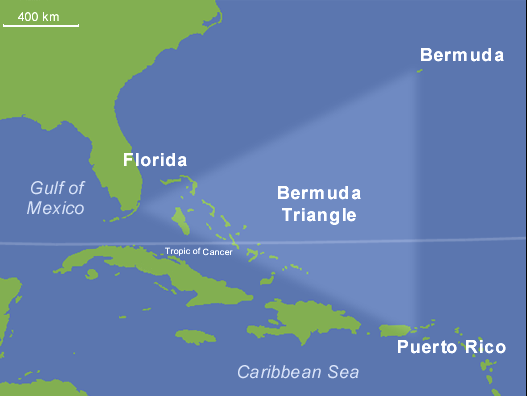
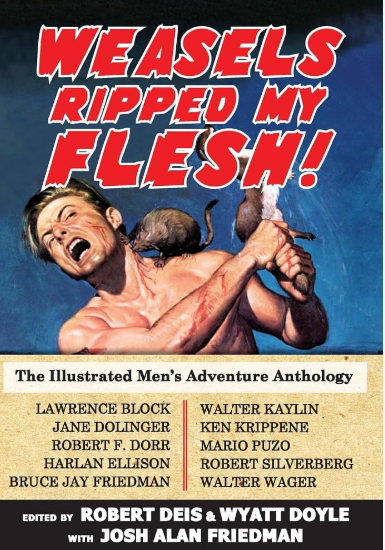
A 1950 Miami Herald story gathered reports of several local disappearances without any specific geometry. The triangle depicted above was suggested two years later in Fate magazine, later in an American Legion outlet and then in Argosy, a men’s adventure magazine of the type parodied in Weasels Ripped My Flesh by “Frank Zappa and the Mothers” (cue Smoke on the Water).
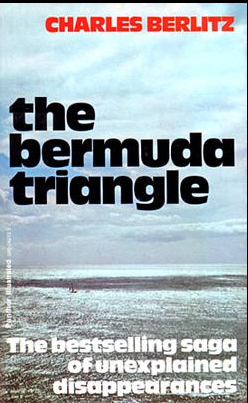
From there it was off to the races. The Triangle joined the litany of paranormal mysteries covered in books and associated television specials. My dear childhood friend and distinguished earth scientist Joe Fassio and I ate up speculative works such as Erich von Däniken’s 1968 Chariots of the Gods?, Hal Lindsey’s 1970 The Late Great Planet Earth, and of course Charles Berlitz’s 1974 The Bermuda Triangle.
What could explain these vanishings? Some remaining impact of the continent of Atlantis? Divine intervention? A time-space warp-portal, as suggested in Close Encounters of the Third Kind (1977)? Or more natural causes like methane releases or magnetic anomalies? These books and shows usually ended sentences with question marks.
A dogged researcher Larry Kusche debunked all this in The Bermuda Triangle Mystery: Solved (1975). I never saw it in the Salinas, California public library, but it sounds devastating. Among the findings of Kusche and later skeptics:
Many of the supposed vanishings simply involved bad recordkeeping or research—a “missing” ship would pop up on arrival logs unearthed elsewhere.
One alleged Triangle occurrence took place in the Pacific Ocean (the port names were confused); another was lost offshore Texas; another sank close to shore at Daytona Beach, Florida seen by eyewitnesses.
Sure enough, bad weather was often associated with disappearances in the Triangle, just as in the world’s other oceans.
That is not to say that there are no unexplained disappearances in this zone. Flight 19—five torpedo bombers that took off eastward from Fort Lauderdale on a training mission in 1945 lost within hours, along with a search craft—remains rather disturbing to this day. But the point is there be mysteries everywhere. The U.S. Navy, the U.S. Coast Guard, the U.S. Board of Geographic Names (a beleaguered agency much in the news these days), and even a specific site of the National Oceanic and Atmospheric Administration (NOAA) all say there is nothing special about the Triangle.
Finally, we may follow the money. Politicians and certain business leaders may deny that considerations of the environment should affect our thinking or conduct. As Upton Sinclair wrote in 1935, “It is difficult to get a man to understand something when his salary [or polling] depends on his not understanding it.”
Insurers do not have the luxury of not understanding something. They price climate conditions into their policies even if governments claim they are hoaxes. See Richard Feynman’s addendum to the 1986 Challenger report: “For a successful technology, reality must take precedence over public relations, for Nature cannot be fooled.” If the Triangle were real, one would expect the applicable Lloyd’s of London vessel and cargo insurance premiums to be higher, and surprise surprise they are not. Seas and skies, all seas and skies, are dangerous places.
Proof of the Bermuda Triangle Impact
Fine, Rob, so what do you mean that an impact of the Triangle has been authoritatively proven? Well, that is exactly what I learned during my Bermudan holiday.*
In Joseph Conrad’s The Heart of Darkness (1899), the sailor Marlow tells of his terrifying and revelatory freshwater snake-river journey. He does so aboard the Nellie, anchored on the Thames beyond the reach of the sea. His listeners included “the Lawyer—the best of old fellows,” who had taken for himself the only cushion and only rug.
Let us imagine that old fellow’s great-grandson Nostromo Glassbottom,** a now elderly admiralty lawyer, spinning this tale to a rapt audience ashore at a resort hotel in Bermuda’s lovely Hamilton Harbour.
Old man Glassbottom begins his yarn.
“Ye know, Bermuda is not a single island. It is all that remains of a volcano, some 181 rocky outcrops inside a reef. A reef that stretches so far that ships can easily run aground before they even come in sight of land.”
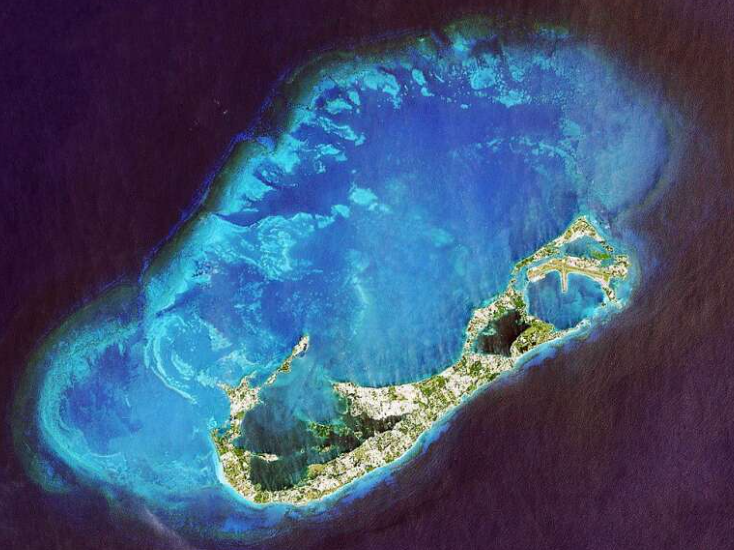
In some weather conditions, a ship can run aground Bermuda without sighting Bermuda.
“So it was that in—when was it?—nineteen hundred and six-and-eighty, the northern reef came into kissing contact with the supertanker Aguila Azteca. She was carrying two hundred thousand metric tonnes of heavy Mayan crude. Bound from Mexico to the Mediterranean, she was. Her and our reef, they met in the ‘convergence of the twain,’ as Thomas Hardy wrote of the Titanic and her 1912 berg-mate.
“The Mexican was unlucky to run aground but we were all luckier, for she did not spill much. Had she broken up, unleashing one-and-thirty million barrels of mucky oil, the damage to our homeland would have been a catastrophe. Some say the entire island might have needed to be evacuated. We learned from that near-miss, I assure ye. Installed beacons all along those far reef reaches, we did, and declared the near ocean off limits to those tankers.
“But run aground this one did in 1986. As the lawyer for the insurers—y’know, they call us ‘proctors in admiralty,’ a far finer title than ‘attorney’—I, Glassbottom of Snorkel & Glassbottom, Esquires, was called on to join the boarding party to inspect the vessel and the damage.
“I had to sign—‘what d’ye call ‘em?’—nondisclosure agreements. ‘I believe I undertook amongst other things not to disclose any trade secrets. Well, I am not going to.’”
The lawyer’s tale was briefly interrupted. A “wild and gorgeous apparition” of a resort-hotel restaurant waitstaff person served the crowd their drinks. Glassbottom swirled his rum.
“Where was I? Ah yes, we boarded the so-called Aztec Eagle and I made my way on the iron ladder up to her bridge. There I espied the master’s paper chart of the entire North Atlantic.
“Something strange about that chart, something caught my eye. It bore the normal sort of fathom soundings and contour-lines, but some of them were missing—white rough blanks where the rest of the map was blue.
“I took it up and held it to the light, and there I saw erasures inscribing the mythical Bermuda Triangle—white-outs in three straight lines. Running from Hamilton to Miami, from Miami to old San Juan, from old San Juan to Hamilton.
“Upon questioning, the master confessed. His fear of the Triangle had led him to draw it on his chart in heavy pencil strokes. When his ship ran aground he hastily erased the pencil, so hard that the erasures showed where the markings had been. The erasures only made sense when the chart was held up to the light, as I had done.
“The superstitious master had regularly sailed north of Bermuda, rather than the usual route south direct to Gibraltar, precisely to avoid sailing through more of the Triangle than was absolutely necessary. But on this particular voyage the engine had broken down, and he lost some eighteen hours to its repair. His desire to recover that delay led him fatefully to shave past Bermuda as close as he could. Too close, as it turned out.”
Old Glassbottom sipped his rum as he wound up his yarn. “A ‘convergence of the twain’ indeed. Thus, my hearties,
‘the Aguila Azteca is the only verifiable victim of the Bermuda Triangle.’***”
###
The lawyer’s audience sat rapt in reflection. Those attentive in their attendance realized, with old Glassbottom,
fear of something unreal is a specimen of reality itself.
In that venerable hotel there hung an ineffable and sultry stillness of the Bermudan air, as old Glassbottom arose and departed.
In Conrad’s words, what we might think is “AI slop” these days,
“It was the stillness of an implacable force brooding over an inscrutable intention.”
###
EVIDENTIARY ENDNOTES
*The 1986 Aguila Azteca spill is described online in the Royal Gazette, inexplicably without mentioning the Triangle.
**I saw this vessel in Hamilton Harbour. Snorkel & Glassbottom sounded like a law firm to me. Or perhaps a Backrooms iteration of a 1960s Greenwich Village folk-rock duo.