Green & pleasant & dark satanic
Christian-ish epics from Dante and Milton to Blake. When were your [I→E] transitions?
Rob James
September 30, 2026
After Paradise Lost no other major English creative writer would attempt to describe the supernatural world … no more Spensers or Miltons.—Karen Armstrong, A History of God (1993)
We all pass from Innocence [I] to Experience [E] at different times of our lives, in different parts of our lives. (Peter Pans, you may be excused.)
My popular music [I→E] happened in eighth grade. I had recently graduated from my parents’ Mitch Miller sing-along LP and The Ray Conniff Singers to Casey Kasem and the American Top 40 countdown every Sunday night. That phase ended when as a junior summer-camp counselor I entered the staff lodge, where guys in their late teens and early twenties played their music. Here there were no spindle-adapters for 45-rpm singles—that July marked for me the division between AM and FM radio music, as brilliantly illustrated in a Dan Aykroyd Saturday Night Live (SNL) skit (brought to you by Stairway to Headphones).
The Seventies were the heyday of the album-oriented rock of The Who (“Tommy, can you hear me?”), Led Zeppelin (contrary to Mike Damone, the second side of the fourth album was preferred as non-cliché), and Emerson Lake & Palmer. ELP’s Brain Salad Surgery fascinated me, from the elaborate fold-out cover (H. R. Giger also designed the biomechanical Alien movie sets), to the Moog synthesizers panning from left to right to left in my stereo headphones, to the space-opera Karn Evil 9 splayed across side A and side B.
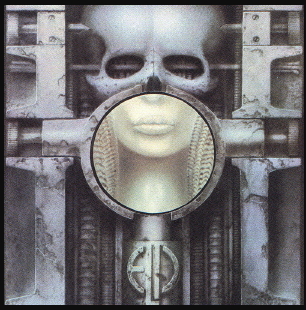
The lyrics of the album’s opening track were especially arresting. You might know them:
And did those feet in ancient time/Walk upon England’s mountains green?
And was the holy lamb of God/On England’s pleasant pastures seen?
And did the countenance divine/Shine forth upon our clouded hills?
And was Jerusalem builded here/Among these dark Satanic mills?
Bring me my bow of burning gold!/Bring me my arrows of desire!
Bring me my spear: O clouds unfold!/Bring me my chariot of fire!
I will not cease from mental fight/Nor shall my sword sleep in my hand
Til we have built Jerusalem/In England’s green and pleasant land.
They were credited to somebody named “Blake,” and I wondered which band member that was. This was way before computers or smartphones, so it was only after the summer was over that I learned that “Blake” was an old painter as well as an old poet. I bought a cool poster that I assumed was Jehovah God the Father hurling a couple of thunderbolts. I deftly coiled masking tape into little beige rings and stuck it to the wall of my college dorm room.
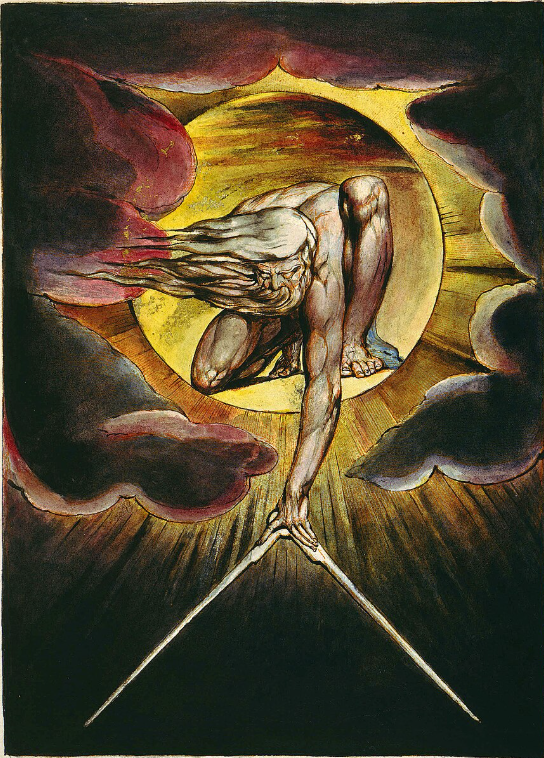
In my junior year, I took an English course that covered Blake. Nope, it turned out that isn’t Jehovah God the Father, and nope, those aren’t thunderbolts!
Blake used Christian concepts, like the idea of a “Jerusalem” beyond the specific Near Eastern city. But he combined them with notions from mythology, literature and his own fevered mind. I found that to understand Blake it helped to be familiar with Milton, and to be familiar with Milton it helped to be familiar with Dante. You can see where this is going. Here is my [I→E] recap of epics (“lengthy heroic works”) that mix Christian traditions with myths of antiquity or of a poet’s own imaginings.
I would add Blake to Karen Armstrong’s comment and then agree that the Supernatural Epic River pretty much runs dry with these writers. Only the song, that song, remains the same. I’ll get back to that stirring anthem, popularly known as “Jerusalem,” when my upriver journey is done.
DANTE ALIGHIERI (1265-1321)
Dante wrote not in Latin but in the Tuscan vernacular thenceforth the model for standard Italian. He was entangled in political battles—first between the victorious Guelphs (Welf was a papist Bavarian house) and the Ghibellines (Waiblingen was a Holy Roman Empire castle), then (since there is no fight like a family fight) between the victorious Black Guelphs and Dante’s more secular White Guelphs. He was bedazzled by little Beatrice di Folco Portinari at age eight or so, when he was already betrothed; she died even before he married (oof, that had to hurt).
It’s a “comedy” because it isn’t a tragedy or a history in Aristotle’s system. Dante’s Comedia was called divina by Boccaccio and The Divine Comedy centuries later. His first-person narrator’s mission is to get to heaven through hell and purgatory, and to so he must pass circles, pits, terraces and celestial spheres filled with the shades of departed souls. The vices and virtues of these souls track the ethical systems of Aristotle and Cicero more than those of the Bible. His guides are Virgil the blessed pagan through hell and purgatory, and Beatrice the believer then St. Bernard the mystic through heaven.
Inferno
I won’t dignify the torture porn in the description of hell, over whose entrance is incorrectly inscribed “Abandon all hope, ye who enter here” (the narrator comes out okay).
Virgil and Dante first see the Uncommitted, angels who took neither side when it mattered most, when Satan rebelled.
[Virgil explained:] “These miserable ways
The forlorn spirits endure of those who spent
Life without infamy and without praise.
They … rebelled not, yet avowed
To God no loyalty, on themselves intent.
Heaven chased them from, lest, being there, they cloud
Its beauty, and the deep Hell refuses them,
For, beside these, the wicked might be proud.” …
And after it there came so long a train
Of people, that I ne’er would have believed
That ever Death so many had undone. [referenced in T.S. Eliot, The Waste Land]
It is instructive to read this passage in 2026. Gentle reader, how will you be remembered for what you did at this hinge of history?
The infernal punishments are contrapasso, karma based on one’s sin. For example, the soothsayers who claimed to see the future have their heads turned round and only see backwards. Dante seems far more interested in settling scores with dead Black Guelphs than in theological matters. Speaking about the future torture of those Italians, Virgil tells an apparently gleeful Dante that “Perfection will grow [in the afterlife] in the rewards for both good and evil.”
Circle Number Eight for the Fraudulent is the residence of Odysseus (Achilles and Homer are in less nasty circles). In Dante’s telling, he never returned to Ithaca—instead sailing beyond the Strait of Gibraltar. This alternative ending is a source for Alfred Lord Tennyson, who envisioned the hero tiring of his resumed kingship, and bolsters Christopher Nolan’s version where both Odysseus and Penelope wind up sailing west allowing Telemachus to reign.
(I liked many if not all of Nolan’s twists, especially Antinous having a back story and dying last like Hans Gruber. Yet “This is not writ/In any book” (Wallace Stevens). It’s fine for Nolan to have his own take: judge any artwork by what the artist intended, not by what you would have done. No one owns the Odyssey, not even Homer and certainly not strange bedfellows Emily Wilson and Elon Musk.)
What else is there to note? Dante breaks the fourth wall a la Jim in The Office: “The new pains of Hell that I saw next demand/New lines for this Canto XX of the first Canzon.” I don’t read Italian but appreciated gawking at a bit of the terza rima aba bcb cdc rhyme scheme. Here is Francesca’s poignant description of her adulterous affair with her brother-in-law Paolo, likened to Lancelot’s trysts with Guinevere abetted by his giant friend Gallehault:
“Nessun maggior dolore
che ricordarsi del tempo felice
ne la miseria; e ciò sa 'l tuo dottore.
Ma s’a conoscer la prima radice
del nostro amor tu hai cotanto affetto,
dirò come colui che piange e dice.
Noi leggiavamo un giorno per diletto
di Lancialotto come amor lo strinse;
soli eravamo e sanza alcun sospetto.
Per più fïate li occhi ci sospinse
quella lettura, e scolorocci il viso;
ma solo un punto fu quel che ci vinse.
Quando leggemmo il disïato riso
esser basciato da cotanto amante,
questi, che mai da me non fia diviso,
la bocca mi basciò tutto tremante.
Galeotto fu ’l libro e chi lo scrisse:
quel giorno più non vi leggemmo avante.”
“The bitterest of woes
Is to remember in the midst of pain
A happy past; as well thy teacher knows.
Yet none the less, and since thou art so fain
The first occasion of our love to hear,
Like one I speak that cannot tears restrain.
One day, to pass the time away, we read
of Lancelot—how love had overcome him.
We were alone, and we suspected nothing.
And time and time again that reading led
our eyes to meet, and made our faces pale,
and yet one point alone defeated us.
When we had read how the desired smile
was kissed by one who was so true a lover,
this one, who never shall be parted from me,
while all his body trembled, kissed my mouth.
A Gallehault indeed, that book and he
who wrote it, too. That day we read no more.”
Purgatorio
From hell Virgil and Dante pop out on the Earth’s Southern Hemisphere in front of the terraced mountain of purgatory. Like most middle episodes (The Two Towers? Dune Two?) it is a bit of a snoozer. Dante admits the troubadour Arnaud Daniel was the “better craftsman of the mother tongue.” Centuries later, T. S. Eliot pays Ezra Pound the same compliment (il “miglior fabbri”) for editing The Waste Land.
Paradiso
Here the guide is Beatrice, since the pagan Virgil cannot enter. They pass a sphere of fire between the Earth and the Moon. Dante is “trans-humanized” so he can hear the music of the spheres and is free of gravity and the need to breathe oxygen. Canto II is surprisingly scientific, noting one can verify by observation that the Moon is mottled and solid.
After passing nine celestial spheres with virtues on display, Dante and St. Bernard ascend to the Empyrean, the non-material abode of God. There is a touch of conventional theology with God as three completely equal circles in the middle of which is Christ.
At the very end, a universal sense of Love transcends all the pagan and Christian references: “I felt my will and my desire impelled by the Love that moves the sun and the other stars.” Dante artfully ends all three parts with the word “stars.” Talk about nailing the dismount!
JOHN MILTON (1608-1674)
Milton was another poet ensnared in wars, in his case as a Puritan serving Oliver Cromwell against Anglican bishops (especially over grounds for divorce), Scottish Presbyterians, and Irish Catholics. He wrote lugubrious early poems like “On the Death of a Fair Infant Dying of a Cough” (opening line “O fairest flower, no sooner blown but blasted”) and more beautiful and enduring ones like L’Allegro (“the cheerful”) (“Come, and trip it, as you go/On the light fantastic toe”). He lost his sight by 1652 but pressed forward: “It is not miserable to be blind; it is miserable to be incapable of enduring blindness” (no surprise he wrote a poem about Samson “eyeless in Gaza”). Paradise Regained (1671) is an extended riff on the three temptations of Christ (Mark iv and Luke iv).
Especially relevant to the left and right impulses to penalize disfavored speech in the 2020s, Milton’s Areopagitica (1644) is an inspiring defense of free expression. He tells any would-be censor to allow Truth to compete and win in the marketplace of ideas!
[T]hough all the winds of doctrines were let loose to play upon the earth, so Truth be in the field, we do injuriously by licensing and prohibiting, to misdoubt her strength. Let her and Falsehood grapple; who ever knew Truth put to the worse, in a free and open encounter?
None of that is why he is renowned today. Paradise Lost (1667, 1674; twelve books larded with classical and Biblical allusions) describes the Fall of Adam and Eve in an attempt to “justify the ways of God to men.” Its blank verse (unrhymed iambic pentameter) became the model for centuries. As apple-chomping (get it?) Donald Sutherland asked in Animal House, is Satan the hero? He certainly gets good lines like “To reign is worth ambition though in hell:/Better to reign in hell than serve in heaven.” Hell lies in “darkness visible” where hope never comes.
The theology seems a bit wobbly—the Son of God has agency apart from God the Father, and the Holy Spirit is kind of unrealized. The work is an extended meditation on the free will of beings created by an almighty God (exactly how does that work?). Satan freely sins (gold-medal-winning sinner), Eve was tempted (bronze-medal), and Adam knew she sinned but joined her anyway (silver-medal). The first couple must leave Eden but the Archangel Michaël consoles them with tales of the post-Flood promise made to Noah and a King Messiah. Henceforth you must find “a paradise within thee, happier far.”
Samuel Johnson quipped that no one ever wished Paradise Lost to be longer. The Romantics considered Satan a dissenting hero, while Eliot, Pound and C. S. Lewis were rather cool on the work for different reasons. Milton has inspired many book titles: Look Homeward, Angel; In Dubious Battle; Eyeless in Gaza; Darkness at Noon; Darkness Visible.
One critic sniped that Milton’s “Of man’s first disobedience, and the fruit” opening doesn’t measure up to Homer’s Iliad (Μῆνιν ἄειδε, θεὰ) (RAGE!) and Odyssey (Πηληϊάδεω Ἀχιλῆος Οὐλομένην) (TWISTY-MAN!) and Virgil’s Aeneid (Arma virumque cano, Trojæ qui primus ab oris) (ARMS AND A MAN!). It’s just the first line, dude! Give Johnny a break.
ALLEGORIES OF THE NILE
(That is an original “malaprop” from Mrs. Malaprop herself (III.iii), in Richard Brinsley Sheridan’s The Rivals (1775).)
Some additional works might be considered Christian-ish epics. They don’t stand up as well, perhaps because their reduction of characters to a constant virtue or vice is repetitive and artificial. Benedetto Croce and Arthur Schopenhauer both disliked allegories. Jorge Luis Borges said, “For all of us, allegory is an aesthetic mistake.” D. H. Lawrence succinctly recalled, “I hated, even as a child, allegory.” For completeness, though, here are some well-known examples.
Edmund Spenser (1562-1599), The Faerie Qveene (1590, 1596). A massive work, 30,000 lines even though it was only half or maybe quarter complete. A cutting critical comment: “Spenser did not live in an age of planning.”
Tale after tale is told of knights, ladies, monsters, and magicians, guided by Gloriana the Faerie Qveene (gee, Elizabeth I, to whom the work was dedicated IN LARGE TYPEFACE, I wonder who that might be?). For example, in “Booke I” the Redcrosse Knight kills the monster Errour; tricked by evil magician Archimago into thinking lady Uma to be unchaste, the couple is reconciled through Arthur. Several layers of allegory are possible: (a) Redcrosse (England) defeats Errour (Catholicism) thanks to Uma (the True Church), or (b) Holiness defeats Error thanks to Truth, or (c) something else.
I knew the late Baseball Commissioner and Yale President A. Bartlett Giamatti loved this work (I cherish Bart’s signature on my diploma). Bart pointed out that “spectacles” of this genre were common in England. He says the later fragments are less allegorical. I didn’t hang around long enough to find out.
Joseph Conrad’s epitaph is “Sleepe after toyle, port after stormie seas,/Ease after warre, death after life does greatly please.” That line is spoken by a character named Despair encouraging suicide!
Spenser invented what is now called a Spenserian stanza, eight lines of iambic pentameter with a hexameter finish. There are archaic words (yclad=clad, ydrad=dreaded) and obsolete spellings and typesetting (mercie, euer, haue). Here’s a sample stanza:
And otherwhiles with amorous delights,
And pleasing toyes he would her entertaine,
Now singing sweetly, to surprise her sprights,
Now making layes of loue and louers paine,
Bransles, Ballads, virelayes, and verses vaine;
Oft purposes, oft riddles he deuysd,
And thousands like, which flowed in his braine,
With which he fed her fancie, and entysd
To take to his new loue, and leaue her old despysd.
Maybe this is your cup of tea; it’s not mine.
John Bunyan (1628-1688), The Pilgrim’s Progress (1678). Another monstrosity of a doorstop, 100,000 words and counting, written in what has been politely described as “a coarse, speech-patterned” style. I was shocked to read descriptions end “and what not” and repetitions like “the fair … is a very great fair.” This is lazy, C-minus high-school product. But boy howdy has Pilgrim’s Progress been popular with a wide public, second only to the Bible at times. Some folks turned their landscapes into Bunyan theme parks!
Our hero Christian travels from the City of Destruction through the Wicket Gate, past the Valley of the Shadow of Death, the Slough of Despond and Vanity Fair, to the Celestial City. He meets folks with self-explanatory names like Obstinate, Pliable, Worldly-Wiseman (seeking heaven with laws rather than faith), Ignorance (seeking heaven with works rather than faith), and Faithful (a martyr).
I found precious few memorable quotes beyond those place and character names. “Dark clouds bring waters, when the bright bring none” was one. Another is “The man that takes up religion for the world will throw away religion for the world,” echoing Seneca’s “Someone who becomes your friend because it pays will cease being your friend because it pays.”
C. S. Lewis (1898-1963), Chronicles of Narnia (1950-1956). Once a proud agnostic or atheist, Lewis became an enthusiastic convert and proselytizer. Mere Christianity was strongly recommended to me but didn’t bowl me over (G. K. Chesterton’s The Everlasting Man was a better read with more modest aims).
On the topic of Christian-ish epics, he wrote the Narnia series of seven books (The Lion, the Witch and the Wardrobe; Prince Caspian; Voyage of the Dawn Treader; The Silver Chair; The Horse and The Boy; The Magician’s Nephew; The Last Battle). The lion Aslan is the constant allegorical figure of Christ. I admire this sentiment: “When things go wrong, you'll find they usually go on getting worse for some time; but when things once start going right they often go on getting better.” It is kind of hard to disprove.
Lewis is considered sexist these days because he says Susan loses interest in Narnia in favor of “nylons, lipstick and invitations.” From a different angle, J. K. Rowling (no stranger to epic controversy herself) in adulthood found him “preachy.” These allegorical works influenced Philip Pullman’s His Dark Materials saga, written from an atheist’s standpoint.
The only nice thing I can say about the Chronicles of Narnia films is that the first one inspired the genius Lazy Sunday SNL skit by Andy Samberg and Chris Parnell (“Roll up to the theater; ticket buying, what we’re handlin’/You can call us Aaron Burr from the way we’re dropping Hamiltons”). Bootlegs of that video catapulted YouTube into the public consciousness in 2005, before the smartphone and before Lin-Manuel Miranda’s Alexander.
“Crazy delicious.” Sorry, where was I?
WILLIAM BLAKE (1757-1827)
Oh yeah, now for the star of my [I→E] journey.
Life
Throughout life Blake had mystical visions, one a tree full of angels and another Satan climbing his staircase. He studied briefly under Sir Joshua Reynolds at the Royal Academy, where he resisted oil painting and abstractions (later saying, “To Generalize is to be an Idiot”). He was a fan of the American and French Revolutions but not of Robespierre and terrorism. His wife Catherine helped with the printing, but their childless marriage was strained early on by Blake’s close connection to his brother Robert and later on possibly by his desire to bring a concubine into their relationship. His grave is a common meeting place for the disgraced spies in the wonderful Apple TV series Slow Horses.
His early works, my favorites, were dead set against the Industrial Revolution, the confinement of imagination by rational science, and dogmatic religion. In The Marriage of Heaven and Hell, the Devil is no less than the Hero! His more complicated and less aphoristic later work featured a more positive program of forgiveness and self-sacrifice, but their lines of fourteen fricking syllables are more like prose than poetry.
“I must create a System, or be enslav’d by another Man’s” (Jerusalem), Blake said, and boy howdy what a complicated system he created. I probably have this scrambled, but I believe four “Zoas,” the beasts in Ezekiel’s vision, were released with a nature-deity Vala upon the fall of man’s and England’s ancestor Albion. The beasts respectively become Urizen (reason), Urthona (imagination), Luvah (passion), and Tharmas (the senses). Each has a female aspect and other emanations, rather like Hindu deities. So my dorm-room poster turns out to be a bad guy, Urizen, imposing hated Rationality and Limitation by surveying the Earth with those accursed caliper points. (Oops. It’s still a cool painting!)
Blake championed imagination over reason, faulting Locke, Bacon and Newton. Like Mary Wollstonecraft, he considered marriage little more than legalized prostitution. In the poem “London,” it is the “Harlot’s Curse” of venereal disease that mars the wedding.
During his lifetime, Blake was considered something of a very talented nutjob. Decades later, the Pre-Raphaelites such as Alexander Gilchrist (1863 Life), Gabriel Rossetti and Algernon Swinburne picked him up. W. B. Yeats and Carl Jung name-checked him, as did the Beats. Aldous Huxley used a quote in his druggy The Doors of Perception, which gave Jim Morrison an idea for the name of his rock band.
Selected Works
Here are some random notes on some of the many poetical, prosaic and artistic works. Be sure to look at the beautiful watercolored engravings and especially the marginal drawings, which remind me of the Sergio Aragones bits in the old MAD magazine.
There is No Natural Religion (1788). “He who sees the Infinite in all things sees God; he who sees the Ratio sees himself only.”
Book of Thel (1789). “Can Wisdom be put in a silver rod?/Or Love in a golden bowl [the Eucharist chalice]?” The unborn Thel asks why youth fades and dies (compare Wallace Stevens, “Sunday Morning” (“Is there no change of death in Paradise?/Does ripe fruit never fall?”)). She resolves to remain unborn.
Songs of Innocence (1789) and of Experience (1794). The two works were surprisingly composed some time apart though together they “shew[] the Contrary States of the Human Soul.” Innocence and Experience are each half-truths. We need both of them to be completely human and completely divine, which to Blake are, when all is said and done, one and the same thing.
I already mentioned my musical [I→E], and this very article is my [I→E] for appraisal of these Christian-ish epics. My literary and film [I→E] might have happened around age ten with 2001: A Space Odyssey and John Updike. My romantic [I→E] definitely happened college freshman year. And my political [I→E] happened…oh, maybe in my early thirties, maybe later, maybe not even yet. Gentle reader, when did you undergo [I→E] in all the aspects of your own life?
Songs of Innocence: The “swift arrow” and “cradle narrow” of “The Blossom” are deceptively sexual. The first “Chimney-Sweeper” has the child laborers cry “[s]weep! [s]weep!” and pray that “if all do their duties,” they might rise from their black coffins to play on heaven’s sunny green. The first “Divine Image” says God exists where Mercy, Love and Pity dwell.
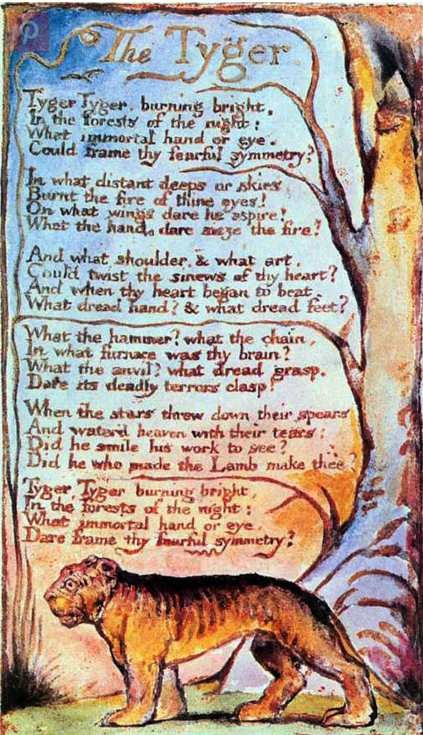
Songs of Experience: “London” and “The Sick Rose” reference venereal disease. “Holy Thursday” is when orphans come to church; they live bleak lives while others live comfortably in a rich land. The second “Chimney-Sweeper” cries “weep, weep!” and condemns those who profit from their misery. The second “Divine Image” observes that Cruelty, Jealousy, Terror and Secrecy also dwell here. “The Fly” (“Am not I a fly like thee?”) and “The Tyger” (“Did he who made the Lamb make thee?”) question the goodness of the universe. “A Poison Tree” foreshadows Freud on repression.
The Marriage of Heaven and Hell (1794). This is my favorite Blake book. He was influenced by Emanuel Swedenborg, viewing the Bible more as a self-help manual than as history. He parted company by saying “the Devil” is a pejorative for an integral and useful part of the divine order.
There are too many good lines (like Chandler Bing’s “too many jokes”). I will just list some choice ones here:
Without Contraries is no progression. Good is the passive that obeys Reason. Evil is the active springing from Energy. Energy is Eternal delight.
The reason Milton wrote in fetters when he wrote of Angels & God, and at liberty when of Devils & Hell, is because he was a true Poet and of the Devil's party without knowing it.
Sooner murder an infant in its cradle than nurse unacted desires.
Truth can never be told so as to be understood, and not be believ'd.
The road of excess leads to the palace of wisdom. Exuberance is beauty. You never know how much is enough without having more than enough.
If the doors of perception were cleansed, everything would appeal to man as it is: infinite.
One Law for the Lion and Ox is Oppression.
Every thing that lives is Holy.
Vala, or the Four Zoas (1797) is the Cliff Notes, SparkNotes or Crash Course summary of the mythology.
Auguries of Innocence (1803). “To See a World in a Grain of Sand/And a Heaven in a Wild Flower,/Hold Infinity in the Palm of your Hand/And Eternity in an Hour.”
Milton (1804). Here resides the preface-poem “And did those feet in ancient time.” Milton returns from heaven on a comet into Blake’s foot (!) and inhabits his body. He encounters the twelve-year-old Ololon (an Edenic river spirit, possibly a stand-in for Blake’s intended concubine). Instead of pithy aphorisms we get convoluted multisyllabic gobbledygooky junk like
The Kingdom of Og is in Orion: Sihon is in Ophiuchus.
Og has Twenty-seven Districts; Sihon’s Districts Twenty-one. (II.42)
Jerusalem (1820). This is the last, the longest and the supposedly “greatest” of Blake’s works. But its text isn’t even excerpted in my college textbook—some greatness! After forgiveness and self-sacrifice, Blake predicts that “Heaven, Earth and Hell henceforth shall live in harmony.” We are a very long way from teachings of any Christian Church, notwithstanding all the Biblical references.
Now, about that Football, Proms and ELP song
The poem was retrieved by Poet Laureate Robert Bridges (who to his undying credit also rescued the amazing poetry of Gerald Manley Hopkins from obscurity). Bridges wanted it for the 1916 “Fight for Right” fundraising campaign during the darkest days of World War I, when hundreds of thousands of men died over tiny amounts of ground on the Western Front (as referenced in Blackadder). It was set to music by Sir Hubert Parry and orchestrated by Sir Edward Elgar—a knight and a baronet.
Note that Parry blunted Blake’s faulting all of us for the dimming of modern England by changing “these dark Satanic mills” to “those dark Satanic mills.” Rarely has a single vowel-shift so altered a meaning. Greg Lake sings “these”; the ELP version never charted (BBC refused to broadcast “Satanic”). The “mills” might refer to the specific Albion Flour Mills, or the Industrial Revolution more generally, or institutional churches; take your pick.
“Jerusalem,” as it is now known, has been belted out in many settings, from the last night of the Proms to meetings of the suffragette Women’s Institute to sports stadiums to political movements of the left, right and ultra-right—even to postcolonial audiences in the Errollyn Wallen setting. It has gone global thanks to the film Chariots of Fire and English football fans everywhere. It is an unofficial anthem of England in particular within the United Kingdom. (Ted Lasso: “How many countries are in this country?” Nathan Shelley and the Beard: “Four countries.” Ted, nodding: “Kind of like America these days.”)
The Anglican Church does not regard “Jerusalem” as a hymn, as it neither praises nor beseeches God. That makes it fully representative of the epics covered here, each of which uses Christian concepts without really being Christian. It is an ode to the England the singer desires the New Jerusalem to be.
As Robert Plant of Led Zeppelin warbled back in that summer-camp lodge, the song remains the same.
Or, as American poet Trumbull Stickney wrote:
I hear a river thro’ the valley wander
Whose water runs, the song alone remaining.
A rainbow stands and summer passes under.