Halley, spirituality, and things unseen
Elle Cordova’s performance of a country song about a comet affords common ground for science and religion.
Rob James
April 11, 2026
Earlier on a Substack comment to a prior blog post, I referred to one of my great heroes, Martin Gardner, as both “a polymath and a polymage.” I applied the latter term to a man who was a great investigator and explainer of many disciplines, and who folded into them an inextricable element of magic. His popularization of works and concepts in each of the discrete fields of mathematics, science, literature, and prestidigitation far exceeded the sum of the parts. His enthusiasm was infectious, and it inspired me and countless others (see the annual Gatherings 4 Gardner). (Hold Martin Gardner for later.)
A polymath is impressive, all right, but a polymage is preternatural. That does not mean supernatural, mind you; Gardner believed in God but was a debunker of pseudoscience and an explainer of magic “tricks.” Preternaturality refers instead to natural experiences somehow beyond the bounds of normal, everyday experience.
Today I apply the “polymath and polymage” title to Rachelle Cordova, known formerly as Reina del Cid and now as Elle Cordova. I first encountered her as the singer and writer of “Candy Apple Red,” performed with her co-writer and lead guitarist Toni Lindgren. The song, accented by Lindgren’s Mark-Knopfler-esque licks, perfectly captures the heat of a romance of a single season, which swooned all too quickly from “that whole summer, 'til we got way too high” to the autumn’s “I can feel your heart was slipping through my hands.”
Elle is a social media regular, posting acoustic performances across folk and pop genres, often jamming with Lindgren and the gifted musician Josh Turner. She posts trenchant political commentary and witty takes on literary styles. My favorite of her many genres is typography, of all things. My Stanford classmate and graphic designer Beth Taylor and I regularly send each other links to Elle’s personifications of Times New Roman, Comic Sans, and Wingdings. I cannot use Courier without thinking of her no-nonsense old-school newspaperman, or the Georgia typeface you see here on Attenuated Subtleties without affecting her faux-Southern accent. The most poignant recurring character is Arial, who hopelessly and sans-serifically pines for her (subscription-only) ideal, the unapproachable, perfect, cocky frat-boy Helvetica.
Another focus for Elle is the mystery and wonder of modern physics. She regularly personifies or sings about complex principles in easy to understand and humorous videos, in which concepts like neutrinos and quanta come to life. Her interests in music, science and literature came together in the form of the song “Halley Came to Jackson.” (Yes, I am finally getting to the theme of today’s post.)
The writer Eudora Welty authored a 1983 memoir of her Mississippi childhood, “One Writer's Beginnings.” In it she mentions her love for Mark Twain (hold Mark Twain for later), and her and her father’s love of the natural world. “I was … indeed carried to the window as an infant in arms and shown Halley's Comet in my sleep.” (Hold that “in my sleep” for later too.)
The country artist Mary Chapin Carpenter composed a 1990 song inspired by this anecdote called “Halley Came to Jackson.” In 1910, a father brings his sleeping child to the windowsill.
Now daddy told the baby sleeping in his arms
To dream a little dream of a comet’s charms
And he made a little wish as she slept so sound
In 1986 that wish came ’round
The wish of course is that his daughter would live to see the return of Halley’s Comet. Now an elderly woman, she is redeeming the hope of her now dead father, some 76 years later. She herself had been fast asleep in 1910. So she is also paying tribute to a faith in something for which she had not even been awake.
Elle’s performance of Carpenter's song is beautiful and worth a listen by anyone. Given the range of Elle’s interests, it is especially evocative to someone interested in science, in faith, and their common embrace of things unseen.
___
Comets—dirty snowballs of water and methane ice in eccentric orbits around our sun—were formed along with the solar system, and have been studied throughout human history. Once considered weather-related, Tycho Brahe used parallax to show they are far beyond the path of the moon. There are plenty of them; comets of all types have appeared every year, so it is super easy to tie one to any historical event like the birth of Jesus, the death of Caesar, or the Battle of Hastings. (But Halley indeed appeared in 1066! Just sayin’).
Sir Edmond Halley witnessed a comet in 1682 with his own eyes, and noted that it shared characteristics with ones in 1531 and 1607. In 1705 he concluded that they were all one and the same thing and predicted it would return in 1758. Alas, he died in 1742 so his personal eyeballs were not around for the next lap. Sure enough, though, a comet appeared in 1758 when and where he foresaw, and in his honor as soon as 1759 it had been given his name.
Halley appeared again in 1835 and of course in 1910, at that time passing close to Earth and presenting one of the most spectacular appearances in recorded history. In 1909, Mark Twain (remember him?) wrote:
I came in with Halley's comet in 1835. It is coming again next year, and I expect to go out with it. It will be the greatest disappointment of my life if I don’t go out with Halley's comet. The Almighty has said, no doubt: “Now here are these two unaccountable freaks; they came in together, they must go out together.”
Twain indeed died the day after the comet’s closest passage. (Confusing modern records, there was a “great daylight comet” in 1910 even brighter than Halley.)
I will add two more comet background anecdotes. “Saint Judy's Comet” is a song I knew from my vinyl LP (purchased at a Sears Roebuck believe it or not!) of Paul Simon’s 1973 solo album There Goes Rhymin’ Simon (better known for “Kodachrome,” “American Tune,” and “Loves Me Like a Rock”). In it, the “famous daddy” sings a lullaby putting his son to sleep while pointing to the “spray of diamonds” left in that object’s wake.
Many years later, I helped my child Caroline with a first-grade science project, “All About Comets.” I learned a lot along with the entire class.
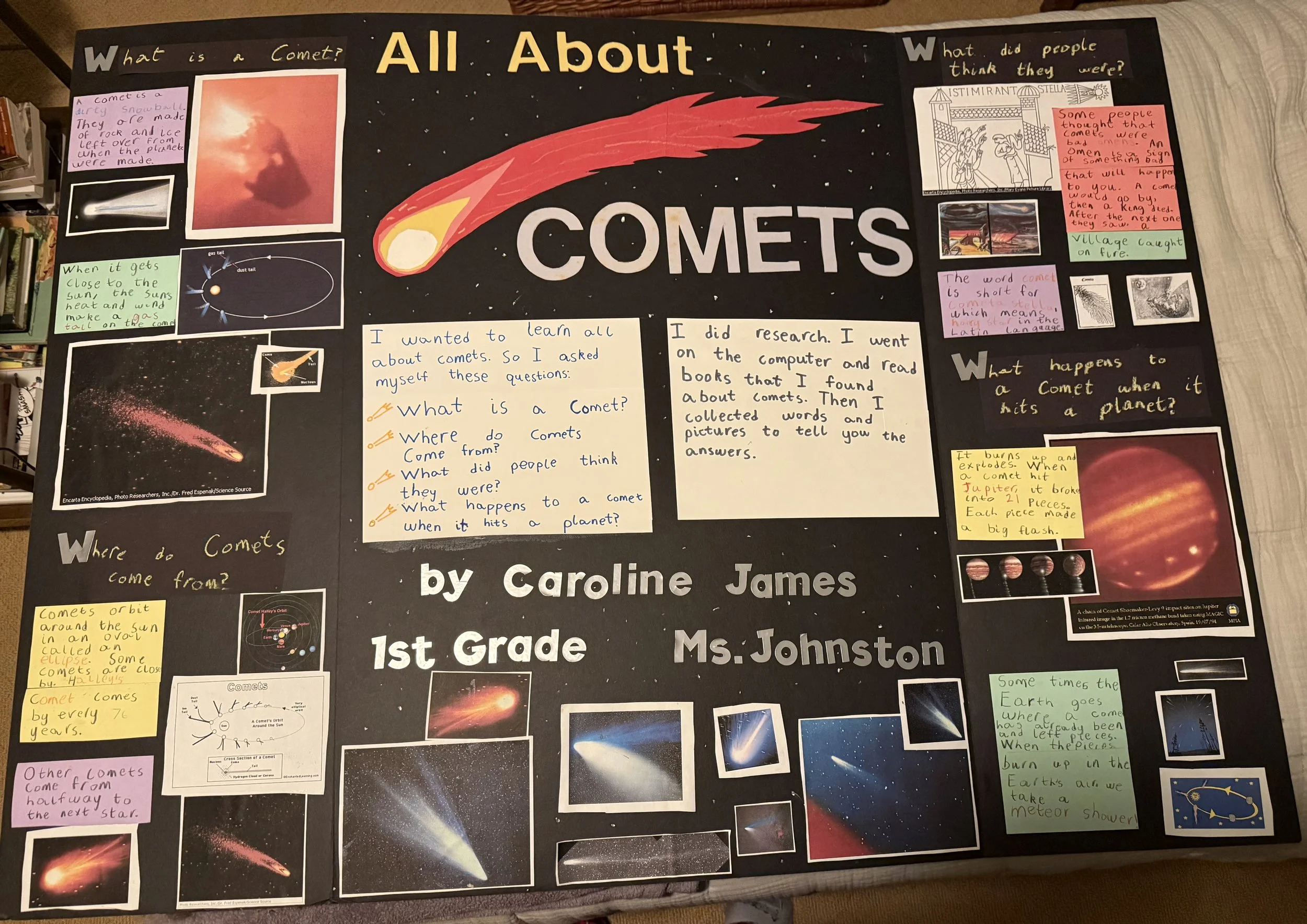
Yup, all about comets.
Given my interest in astronomy, I was excited about the reappearance of Halley in 1986. The physician father of my law school classmate Mike Jacobs was an amateur astronomy enthusiast, and he and another physician brought out their elaborate equipment one night in early 1986 to witness the event. I was grateful to be invited to tag along with Mike and them.
I did not know this at the time, but Wikipedia informs me in 2026:
The 1986 apparition of Halley's Comet was the least favourable on record. The comet and the Earth were on opposite sides of the sun, creating the worst possible viewing circumstances for Earth observers during the previous two thousand years. … Additionally, increased light pollution from urbanization caused many people to fail in attempts to see the comet. Further, the comet appeared brightest when it was almost invisible from the Northern Hemisphere. [RAJ: Emphases added to rub salt in my wounds.]
Oh.
Back in 1986, our intrepid little group traipsed around the hills of Marin County, California, searching for the best vista of where the almanacs said Halley was lurking. We looked and looked, all through a night largely obscured by clouds. Finally, we thought we saw a part of the sky that was maybe a little lighter than the surroundings. By a unanimous vote, of five or so to nothing, we resolved that we had seen Halley's Comet. It was an astounding confluence of astronomy and democracy.
The fact that we had to cast a vote to say whether we had seen something did not diminish our belief in the comet itself. After all, we were people of science and, to greater or lesser degrees, people of faith. Whether as a matter of theology or as a matter of astronomy, or both, we were confident that there was something there.
—-
Rationality and belief sit comfortably side by side on this topic. First, consider religion. In Christianity, for example, the Apostle Paul stressed the importance to humans of things that humans don’t see. “Faith is the substance of things hoped for, the evidence of things not seen”; “Things which are seen are temporal, but the things which are not seen are eternal” (Hebrews 11:1; 2 Corinthians 4:18 KJV).
Believers refute the argument of skeptics that they cannot believe in God because they cannot verify his existence by utilizing the senses. They infer the existence of God from his effects in the world which are all around us. Faith inspires them to understand the things not seen as equal marvels of God's creation.
Faith often inspires scientific curiosity, even the beginnings long ago of the curiosity now pursued by people who have lost some or all of that religion. The belief in a rational, orderly universe created by a wise and consistent God provided the philosophical foundation for the rise of modern science in the West. C. S. Lewis noted that people first became scientific because they expected law in nature, and they first expected law in nature precisely because at the time they believed in a Lawgiver.
Second, consider science. In the 2005 New York Times article “Science and Religion Share Fascination in Things Unseen,” physicist Lawrence M. Krauss writes:
It seems that humans are hard-wired to yearn for new realms well beyond the reach of our senses into which we can escape, if only with our minds. It is possible that we need to rely on such possibilities, or the world of our experience would become intolerable. Certainly science has, in the past century, validated the notion that what we see is far from all there is.
Then Knauss crosses the Ghostbusters twin streams.
It is perhaps not surprising that when one approaches the limits of our knowledge, theologians and scientists alike tend to appeal to new hidden universes for, respectively, either redemption or understanding … [f]or very different reasons, but still without a shred of empirical evidence.
So science and religion play on the same team here, though not on the same basis. Well, who stands athwart both science and religion regarding things unseen?
One cohort consists of those we associate with conspiracy theories, who only trust the evidence of their eyes and fear dark opposing forces elsewhere. We know this landscape by its peak fascinations: the John F. Kennedy assassination, a faked moon landing, a unitary cabal of elites that runs the world, and especially the Flat Earth.
Michael Marshall is project director of the Good Thinking Society, a group channeling the spirit of Martin Gardner to promote science in order to challenge pseudoscience. He has spent many years in conversation with conspiracists trying to understand the source of and basis for their convictions. He reports in a 2020 Scientific American interview that sometimes the explanations are very simple. When we look at the horizon ourselves, at sea level or even from a tower, we detect no curvature. We have a difficult time intuiting from ordinary experience how a body of water could stick to the surface of the globe.
At other times, Marshall says the explanations are more sophisticated, even ingenious. One challenge to Flat Earth theories is how to justify gravity, if not a force pointed at the center of a sphere. Some propose that it is the Flat Earth itself that pushes upward against objects. That push is the acceleration we observe as 9.8 meters per second squared. The sophisticated counter-argument is that a constant acceleration over all universal history would cause the Earth to travel at a rate rapidly exceeding the speed of light. And the sophisticated counter-counter-argument is to use—get this—Einstein’s special and general theories of relativity! To make the theory fit the observations, the clever conspiracists say we have all been changing size and time.
The arguments are contrived, ad hoc, isolated, and elaborate (sounds like a law firm name). What is common and at root is denial of the existence of things unseen. A person who only believes in things he or she can see is neither scientific, nor religious, nor even more generally spiritual. Count me out.
___
All of this takes me back to Eudora Welty, to Mary Chapin Carpenter, to my immediate artistic inspiration Elle Cordova, and yes, all the way back to that champion of both science and faith Martin Gardner. They collectively bring me to that child asleep at a 1910 windowsill, and to that elderly woman redeeming her departed father’s wish in 1986—unfortunately, a redemption probably not shared by my physical senses in Marin County, despite our fancy astronomical apparatus.
All of these figures, even my visually disappointed crew, in some way are non-eye witnesses who were or are simply present at the presence of something. What something? Well, something polymagical, and something preternatural.