Homeleaving
Departing a town that was once an entire world, in life and American literature.

Alma mater.
Rob James
February 20, 2026
In my second year of law school, when I was four-and-twenty, I facetiously suggested a way to list music in legal footnotes. Lawyers are extremely fussy about citation form, yet in 1982 there was no accepted way to refer to recordings in a law review article, brief, or judicial opinion. If there were no “correct” format, my friends and I knew that cautious attorneys and professors would avoid mentioning great works of art in their writing, even where compellingly relevant. That was a shame. Something needed to be done, and by someone.
So we published an article with the quaint title A System of Citation for Phonograph Records. My culminating example was of homecoming.
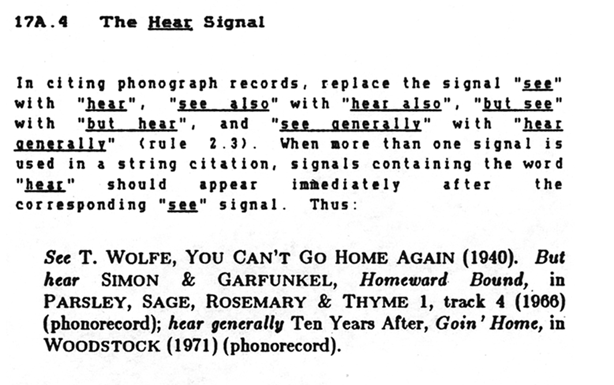
Injecting style in a style manual.
The humor is sophomoric. My only excuse is that we were (law-school) sophomores.
Amazingly, something very like our system (minus the hear signal) appeared in a new edition of the official style manual, A Uniform System of Citation! Musical references in articles and cases shot right up thereafter. One law review article said (at footnote 27) that we students and our Journal of Attenuated Subtleties were the “real pathbreakers” in advancing this cause.
So: is it true that “you can’t go home again”?
I then lived in New Haven, Connecticut. But I was a permanent resident of Salinas, California. “Permanent” is the word I would have used at the time. Salinas was home in every possible sense of the word.
I was born there. I grew up there. I lived in the same house, dialed (and I mean “dialed”) the same telephone number; my dad had the same job, my mom the same bridge club. The town was my entire world. Sitting in the back seat of a Pontiac on trips up and down the state, or on longer treks to and from Iowa on Interstate 80, I didn’t treat any land as anything but foreign ground. I stretched out my limbs but my roots were firmly planted.
Fast forward four-and-forty years. This spring, in 2026, I am emigrating from the state, moving with my wife to the East Coast. On a final California-resident trip to Salinas, I visited the graves of my parents and brother at a cemetery adjacent to a subdivision, where I simultaneously contemplated Eternity, the Choir Invisible, and the illuminated Denny’s restaurant sign in the middle distance.
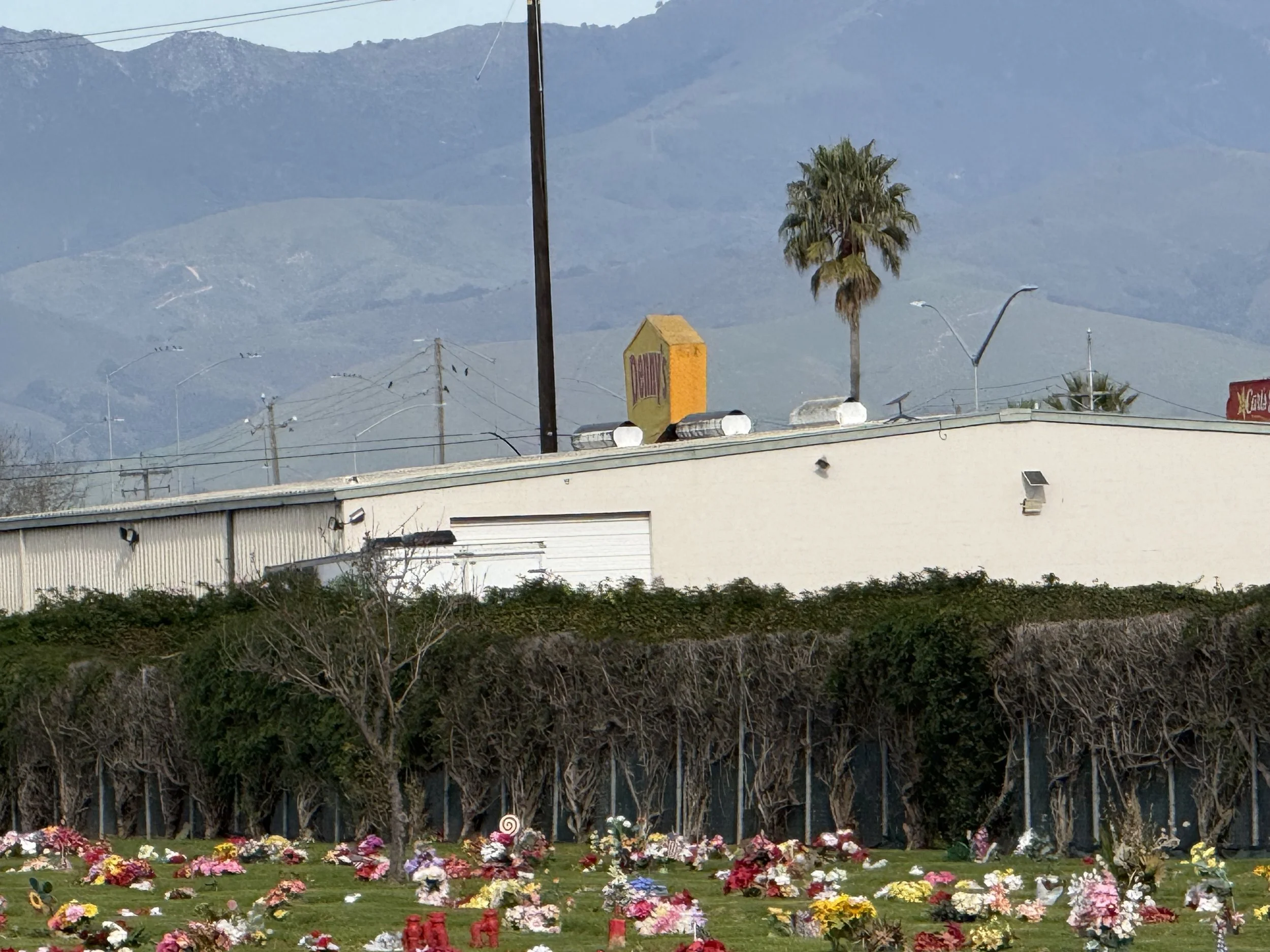
Garden of Memories and Pancakes, Salinas.
I toured the grounds of my beautifully renovated high school and dined at a restaurant (both on the main street, which is named “Main Street”) with a dear lifelong friend and classmate. I drove by each of my key landmarks: grade, middle and high schools, parks, and the houses where something important happened.
What emotions swell, surge and surface when you depart an origin with some measure of finality? I cross-examined my own heart, and I looked to the literature of American towns for passages on homeleaving.
There are zillions (well, a lot) of cultural references to homecoming. From ancient epics of Odysseus and Oedipus, to the Harold Pinter play, to high-school football-and-dance sitcom episodes. There are instances of “leaving home” and “going home,” including a Mark Knopfler song from one of my favorite soundtracks and movies, Local Hero (1983). I don’t see a reference to the one-word concept “homeleaving,” though, so claim it for my own.
I didn’t touch tales of the deep South, like To Kill a Mockingbird (1960) (Dill’s model Truman Capote was someone who really homeleft!) or Absalom, Absalom! (1936) (Quentin Compson having homeleft Yoknapatawpha for Harvard). I lack the innate understanding to step into those unguided. My Western upbringing by Midwestern parents, and my Yale days, make other places serve just as well for this commonplace book(let) on homeleaving. (Spoiler alert, obviously; if you see a name or title you want to save for later, then leap over.)
John Steinbeck, East of Eden (1952) and Travels with Charley in Search of America (1962).
I can’t very well homeleave without paying homage to my home’s most well-known homie. I went to the same college, the same high school, and even a primary school built on the grounds of his primary school.
Steinbeck was reviled in his own region for his depiction of growers in works like The Grapes of Wrath (1939). My Stanford English professor Tom Moser said that when he went to the Salinas public library in the late 1950s to research the writer, the librarian told him with a huff, “We don’t speak that name in this town.” Moser was amused that after the Nobel Prize was awarded in 1962, that same institution was renamed the John Steinbeck Library after the now famous (and eventually late) native son and tourist attraction.
East of Eden often alludes to the Salinas of my experience. In chapter 39 the villainess Kate Albey (formerly Cathy Trask) shops at Porter & Irvine’s department store, where I bought my Scout badges, and I will have you know my mother played bridge with Mrs. Irvine. Now the townsfolk shop at national chains like Pottery Barn and Restoration Hardware, and they know neither Mrs. Barn nor Mr. Restoration.
Still, I found no crystallized homeleaving. Travels with Charley is more poignant, as John’s cab-over-camper truck Rocinante (the name of Don Quixote’s horse) briefly rolls through:
The place of my origin had changed, and having gone away I had not changed with it. In my memory it stood as it once did and its outward appearance confused and angered me. … When I went away I had died, and so became fixed and unchangeable. My return caused only confusion and uneasiness. Although they could not say it, my old friends wanted me gone so I could take my proper place in the pattern of remembrance—and I wanted to go for the same reason. Tom Wolfe was right. You can’t go home again because home has ceased to exist except in the mothballs of memory.
He homeleaves shaking off the dust of his feet, as it were.
(What of Thomas Wolfe, anyway? I found to my surprise that he wouldn’t do for my purpose. One, he hails from North Carolina, beyond my geographic ken. Two, I found his style pretentious and self-conscious (“you can’t go … back home to a young man’s dreams of glory and of fame…back home to the escapes of Time and Memory,” and similarly purple prose). Maxwell Perkins and Edward Aswell said they were mere editors, but I bet they enhanced Look Homeward, Angel (1928) and You Can’t Go Home Again (1940) far beyond the quality of the manuscripts.)
Grace Metalious, Peyton Place (1956).
The incendiary opening to this scandalous work of the Eisenhower Administration reminds us that, as S. E. Hinton quoted Robert Frost in The Outsiders (1967), “nothing gold can stay”:
Indian summer is like a woman. Ripe, hotly passionate, but fickle, she comes and goes as she pleases so that one is never sure whether she will come at all, nor for how long she will stay.
Constance MacKenzie homeleaves the New Hampshire town, only to homereturn a bit tarnished and, in the words of the Rolling Stones ballad Faraway Eyes (1978), “worse for wear and tear.”
The novel is namechecked in the Jeannie C. Riley hit Harper Valley P.T.A. (1968): “This is just a little Peyton Place and you’re all Harper Valley hypocrites.” I wager that after Momma “socked it to” those ladies and gents (does anyone out there remember Laugh-In?) she homeleft, maybe to Knoxville…
James Agee, A Death in the Family (1957).
…which is where my next homeleaving happens. It is a larger and Southern city, but the kids are chasing fireflies on an humid night, and that sufficiently reminds me of Iowa Augusts.
The homeleaving at the end is that of a boy upon the loss of his father. The hypnotic prelude is Knoxville: Summer, 1915, later set to music by Samuel Barber. Float along the river of memory:
We were talking now of summer evenings in Knoxville, Tennessee, in the time that I lived there so successfully disguised as a child. Supper was at six and was over by half past. There was still daylight, shining softly and with a tarnish, like the lining of a shell.
Now is the night one blue dew, my father has drained, he has coiled the hose.
Low on the length of lawns, a frailing of fire who breathes.
Content, silver, like peeps of light, each cricket makes his comment
over and over in the drowned grass.
A cold toad thumpingly flounders.
Within the edges of damp shadows of side yards are hovering children
nearly sick with joy of fear, watch the unguarding of a telephone pole.
Around white carbon corner lamps bugs of all sizes are lifted elliptic, solar systems.
Big hardshells bruise themselves, assailant: he is fallen on his back, legs squiggling.
Parents on porches: rock and rock. From damp strings morning glories
hang their ancient faces.
The dry and exalted noise of the locusts from all the air
at once enchants my eardrums.
May God bless my people, my uncle, my aunt, my mother, my good father, oh, remember them kindly in their time of trouble; and in the hour of their taking away.
After a little I am taken in and put to bed. Sleep, soft smiling, draws me unto her: and those receive me, who quietly treat me, as one familiar and well-beloved in that home: but will not, oh, will not, not now, not ever; but will not ever tell me who I am.
Shirley Jackson, The Lottery (1948).
Some homeleavings are harsher than others. Jackson’s ever disturbing story is like a terrifying triptych, akin to Hieronymus Bosch’s The Last Judgment:
[left panel] The morning of June 27th was clear and sunny, with the fresh warmth of a full-summer day.
[middle panel] Bobby Martin had already stuffed his pockets full of rocks. … Old Man Warner snorted, “Used to be a saying about ‘Lottery in June, corn be heavy soon.’”
[right panel] “It isn’t fair, it isn’t right,” Mrs. Hutchinson screamed, and then they were on her.
Yeesh.
William Inge, Picnic (1953).
I took an understandably popular course at Stanford, “Human Sexuality.” A guest speaker my year was Hollywood icon Julian Blaustein (producer of the original The Day the Earth Stood Still among other flicks). Trying to prove to seventies kids that sex was not just a skin game, Blaustein ran the scene in the 1955 film version of this play where the fully clothed Kim Novak as Madge and William Holden as Hal dance to “Moonglow.” The stage direction is overwrought (“the dance has something of the nature of a primitive rite that would mate the two young people. The others watch rather solemnly”) but the effect on me was, uh, palpable.
The smartass kid sister Millie can’t wait to homeleave Kansas: “Madge can stay in this jerkwater town and marry some ornery guy and raise a lot of dirty kids. When I graduate from college I’m going to New York, and write novels that’ll shock people right out of their senses.” But Madge surprises everyone and homeleaves herself, for an uncertain future with a restless drifter.
Larry McMurtry, The Last Picture Show (1966).
As good as the book is, the 1971 Peter Bogdanovich film is even better. The movie theater and the other businesses in a small Texas town are owned by Sam the Lion. There was one girl desired above all others, the blonde daughter of a wealthy man and his unhappy wife Lois. Restless Jacy dallies with the fullback, with the rich kid, with the roughneck, and with softie Sonny, leaving them all in her wake as she homeleaves for college.
Sam the Lion takes Sonny fishing at a watering tank. The camera artfully zooms in then out on the old man:
Sam: You wouldn’t believe how this country’s changed. First time I seen it, there wasn’t a mesquite tree on it; or a prickly pear, neither. I used to own this land, you know. First time I watered a horse at this tank was more than forty years ago. I reckon the reason why I always drag you out here is probably I’m just as sentimental as the next feller when it comes to old times. (pause) Old times.
I brought a young lady swimming out here once. More than twenty years ago. It was after my wife had lost her mind, and my boys was dead. Me and this young lady was pretty wild, I guess; in pretty deep. We used to come out here on horseback and go swimming without no bathing suits. One day, she wanted to swim the horses across this tank. Kind of a crazy thing to do, but we done it anyway. She bet me a silver dollar she could beat me across; she did. This old horse I was riding didn’t want to take the water. But she was always looking for something to do like that. Something wild. I bet she’s still got that silver dollar.
Sonny: Whatever happened to her?
Sam: Oh, she growed up. She was just a girl then, really.
Sonny: Why didn't you ever marry her after your wife died?
Sam: She was already married. Her and her husband was young and miserable with one another like so many young married folks are. I thought they'd change with some age, but...didn't turn out that way.
Sonny: Being married always so miserable?
Sam: No, not really. ’Bout eighty percent of the time, I guess. We ought to go to a real fishing tank next year. Naw, it don’t do to think about things like that too much. She was here I’d probably be just as crazy now as I was then in about five minutes. (laughs) Ain’t that ridiculous? Naw, it ain’t really. Because being crazy about a woman like her is always the right thing to do.
Sam dies and the businesses fold or sag; it is as if the town homeleaves itself. Jacy’s mother Lois cries at his funeral, and in the movie is flattered when Sonny perceptively asks whether she is the girl, the girl with the horse and the silver dollar. Lois stops crying long enough to smile and reply, sentimentally, “He told you ’bout that, huh?” (This dialogue conveys the story much better than the intrusive book narration.)
Near the end Sonny is desperate to relieve the pains of lost romances, lost friends, lost town. He floors his accelerator past the city limits to go anywhere. But there is no homeleaving, no escape from who and where he is. From outside we see the truck slow, stop, pause, U-ey, and homereturn to take him back to the older woman he wronged.
The significance of venturing beyond a city’s limits rings true for me. After I homeleft for San Francisco, I would fly over Salinas, from OAK or SFO to LAX or BUR, in about ten seconds. I marveled how small my once entire world was from that altitude and attitude.
Sherwood Anderson, Winesburg, Ohio: A Group of Tales of Ohio Small-Town Life (1919).
This short-story cycle revolves around lives of lonely, longing “grotesques,” most featuring young reporter George Willard first as witness and later as protagonist. If you have read it, do yourself a favor and savor a wicked 2001 story from The Onion, one of their best, “Wal-Mart Opens Store in Winesburg, Ohio.”
The two concluding tales floor me. In “Sophistication,” Helen, the banker’s daughter, sits on the veranda with her Cleveland college instructor, a small-town guy who puts on city airs. George fumed as he saw the couple at the fair that whole day. Just as he summons the courage to see her no matter what, she darts from the veranda, desperate to get away. He takes her hand. “Now that he had found her George wondered what he had better do and say.”
They laughed and began to pull and haul at each other. In some way chastened and purified by the mood they had been in, they became, not man and woman, not boy and girl, but excited little animals. It was so they went down the hill. In the darkness they played like two splendid young things in a young world. For some reason they could not have explained they had both got from their silent evening together the thing needed. Man or boy, woman or girl, they had for a moment taken hold of the thing that makes the mature life of men and women in the modern world possible.
In “Departure,” George homeleaves the very next morning. On the train, he thinks of all the people he knew, Helen included (she comes to the station, alas too late to see him).
The young man’s mind was carried away by his growing passion for dreams. One looking at him would not have thought him particularly sharp. With the recollection of little things occupying his mind he closed his eyes and leaned back in the car seat. He stayed that way for a long time and when he aroused himself and again looked out of the car the town of Winesburg had disappeared and his life there had become but a background on which to paint the dreams of his manhood.
I have always liked that ending, that his life in that town was “a background on which to paint the dreams of his manhood.” Painting reminds me of an entire poem of Wallace Stevens containing no words but colors:
Pale orange, green and crimson, and
white, and gold and brown.
Lapis-lazuli and orange, and opaque green,
faun-color, black and gold.
Stevens wrote, “A myth reflects its region… Here in Connecticut, we never lived in a time/When mythology was possible.” I reject that. We moderns (in any state) make our own myths every day, tales that outlast time.
We shall not cease from exploration
And the end of all our exploring
Will be to arrive where we started
And know the place for the first time.
Thus Tom Eliot, who homeleft St. Louis to rebrand as “T. S.” in London, rarely to backlook.
I cannot claim truly to know my town, but at least I tried to know her and me better through life and letters. As I passed those city limits last week, I certainly discovered that homeleaving is sweetbitter.

20 Santa Rosa Avenue, Salinas, California. No historical plaque yet.