The Mitteleuropa Sentence
Pulling on a thread, I find that even the tiniest fray in literary fabric can produce an immense amount of material.
Rob James
August 22, 2026
In the words of the Twin Peaks Giant, “It is happening again.” Here I am, minding my own business reading about French literature, when I hit a passage (edited) where a famous novelist sizes up the past century’s fiction:
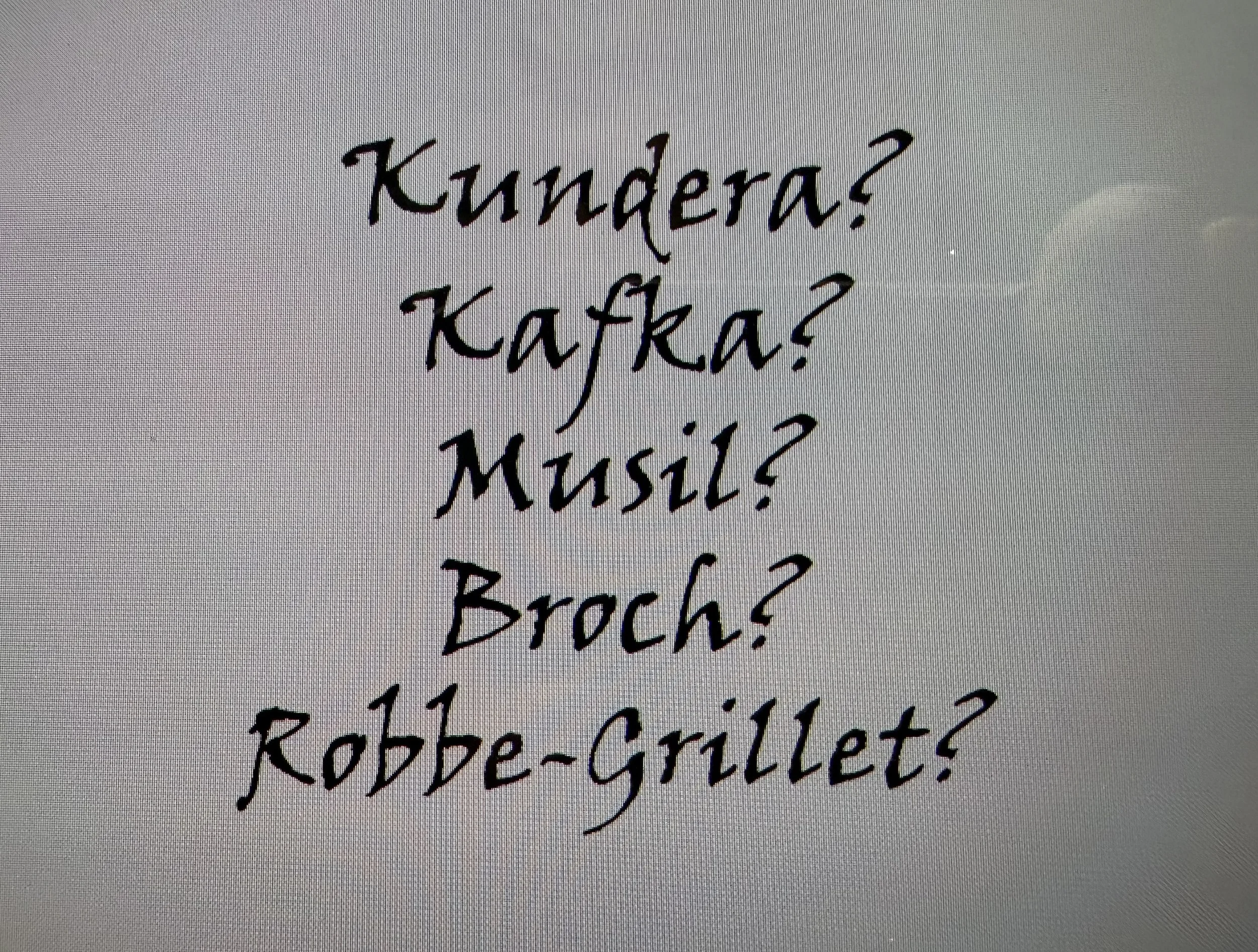
In Kundera’s view something tragic had happened to the novel in the nineteenth century, when naturalism became its dominant aesthetic. Until that moment, he argued, the genre had been rife with experimentation, encompassing the picaresque, the epistolary, and the novel of ideas, characterized by philosophical and essayistic digressions, the whole leavened with irony and humor. In Kundera’s telling, it was as though the novel, once a bountifully leafing tree, had lost some of its most lustrous foliage as it grew. The modern novels he admired most—books by Kafka, Robert Musil, and Hermann Broch—were the ones he believed paid homage to this earlier, luxuriant period in the genre’s history … [and he disliked the gamesmanship in novels by Robbe-Grillet].
I don’t know how many times I have encountered a sentence like that, with names of Famous Authors I Am Supposed to Know … But I Don’t.
I bet you have also seen references like that (and if you say you haven’t, I don’t believe you). Sometimes the famous names are even “adjectived,” as if calling something “Althusserian” (“adj., in the mode of the thought of Louis Althusser”) could do anything other than win Bad Writing Prizes.
Most of the time I mentally sigh and skip over the passage, oblivious to whatever point is being made. It is slightly embarrassing, but by now my ego is calloused. Vaguely stung, I move along, move along, nothing to see here. “Another man might have been angry, another man might have been hurt…”
“Then again, no.” Now that I’m retired, I’ve got world enough and time. I can call a time out and tackle the Case of the Presumptuous Sentence!
Here is my Compensatory Culture take on the lives and works of these Austrian, German, and Czech writers. (Robbe-Grillet is French but you will soon see why I lump him here.) A basic understanding will be sufficient to make sense of a name-dropping passage like this, which I hereby dub a “Mitteleuropa Sentence.”
Spoiler Alert for the plots, and Rambler Apology for the digressions on a bevy of other Mitteleuropeans, lesser-known examples of what Peter Watson has called the German Genius. “We may never pass this way again.”
Milan Kundera (1929-2023)
The Czech author Kundera (a French émigré) is best known for The Unbearable Lightness of Being (1984) (Nesnesitelná lehkost bytí), which I bought and skimmed after seeing the 1988 Philip Kaufman film. Kundera contributed a poem but hated the final product for some reason. All I remember is seeing the beautiful Lena Olin wearing a bowler hat in a love scene and thinking, “Golly, now this is an arthouse movie.”
Kundera’s motive is to counter the “eternal return,” the conviction that everything should be thought of as endlessly repeated. What if it’s the other way around—nothing will ever be repeated, so anything done once can be flushed from memory and existence? In the opening passage, the narrator or the womanizing surgeon Tomáš asks why these European lovers or anyone else should care if thousands of African warriors died in some forgotten battle some centuries ago. None of the love affairs has gravitas, rather proving his point if you buy it (personally I don’t; even if things don’t repeat they rhyme and as Erich Auerbach (1892-1957) shows, artists employ mimesis to explore the echoes). But I do reckon Kundera qualifies as a prominent novelist of ideas and to that extent is qualified to comment on the fiction of the ideas of others.
Franz Kafka (1883-1924)
This one should be easy. Everyone knows Very Big Deal Kafka, right? Why just last Tuesday, I told my wife that procuring Medicare Parts A, B, D and G was “Kafkaesque.” It’s the indispensable adjective to characterize surreal predicaments and incomprehensible bureaucracies.
But do I know Kafka? I thought I knew the first sentence of The Metamorphosis (1915) but it turns out the word “cockroach” is not there (it’s Ungeziefer “vermin” and entomologist Vladimir Nabokov (1899-1977) says it is probably some kind of beetle). I couldn’t say that I had already read Kafka, no. So it was off to Project Gutenberg and the like to read some landmarks.
Franz was a German-speaking Jew in Bohemia (what became Czechoslovakia), making him a stranger in concentric strange lands. His Deutsch is said to lack the informalities of colloquial speech. (My son said using his college-academic Arabic on the streets of Cairo made him sound something like Shakespeare ordering a coffee in modern London.) He worked for an insurance company where he reviewed cases of factory workers horribly maimed, unfortunately becoming one with their machine in the wrong sense of the term.
In the aforementioned Metamorphosis, Gregor Samsa is confined to his room, a rotting, dust-gathering, dung-adhering … beetle. He still tries to be gracious and not to run afoul of others at home, the housecleaner, his co-workers, and his boss. (This reminds me of the Mike Birbiglia comedy routine “My Girlfriend’s Boyfriend’s Parents,” where Mike still wants to make a good impression in that awkward setting. I had a similar life experience.) After the flow of Gregor’s last breath, his relieved family goes on a respite picnic. His sister is“stretching out her young body” as they arrive and the story ends.
The German title Der Process (1925) is much better than The Trial; again in the wrong sense, it’s the journey not the destination that matters. I do accurately remember this first line: “Someone must have slandered Josef K., for without having done anything wrong, he was arrested one morning.” It is a slowly unfolding disaster. An examiner asks, “You are a house painter?” and Josef has to respond, “No, I am the chief clerk in a large bank.” There are surreal touches: a guard is armed with a sword in an aluminum sheath, and the police who arrested him themselves are flogged. The case documents are not made available to the court: “This is all very regrettable,” the judge says, “but not entirely without its justification.” The process is intriguingly called a “court organism.” The ending is strangely counterfactual: “it was as if (als ob) the shame of it should outlive him.” (Counterfactuals were explored by Hans Vaihinger (1852-1933) in The Philosophy of As If, which I encountered in Legal Fictions by the American scholar Lon Fuller.)
I skimmed The Castle, which K. is endlessly seeking to access from the nearby village (“whatever one does, it’s always wrong”); the final chapter is missing, as is much of the posthumously released Amerika. The literally graphic violence of “In the Penal Colony” (1919), the crowd-pandering circus of “The Hunger Artist” (1922), and the tesseracting of time and space in “The Country Doctor” (1917) are surreal. I’ve seen enough; the adjective “Kafkaesque” is sufficient for my uses thereof.
Robert Musil (1880-1942)
Musil started out as an engineer who designed a nifty wheel (still in use) that spins different hues and concentrations of paint swatches to show the resulting blend. He turned to literature over time. He met Franz Kafka in Prague (somewhat famous by then) and Rainer Maria Rilke (1875-1926) in Vienna (who Musil felt became too sentimental in his later poetry). Only eight people attended his cremation.
Musil’s incomplete masterpiece is The Man Without Qualities (Der Mann ohne Eigenschaften). Make no mistake, he is a Very Big Deal. The book (a library, really) is regularly ranked as one of the Top Ten, Top 20 or Top 100 works in all of world literature; one critic compares his place in modern literature to that of Dostoevsky, Tolstoy and Balzac; another merely positions him with Proust, Joyce, Kafka, Mann, and Woolf for the first third of this century; a third says his book inspired the classic Italian films 8½ and La Notte.
Now I hope you feel as dumb as I do. Or take Jane Smiley’s word for it: Qualities is “one of the most prestigious novels of the 20th century; the sort of book no one has read but everyone has heard of.” In other words, Musil is the perfect subject for a Mitteleuropa Sentence—you can cite him and never fear that someone who reads you has read him.
Volume 1 (1930) has the first two parts (I, A Sort of Introduction and II, The Like of It Now Happens) and Volume 2 (1933) has some of a third part (III, Into the Millennium). He left Volume 3 with some more stuff and it was edited and published posthumously. It totals about seventeen hundred pages and what’s worse there are multiple alternative and contradictory chapters—the mess was even made available on CD-ROM (“Daddy, what’s a CD-ROM?”).
I figure that if Musil didn’t have the common decency to finish and polish the thing, I don’t have to feel bad not reading much of it. I am justified in only scrolling the first X Kindle sample pages and consulting some secondary material.
The first spoken dialogue is “These heavy lorries they use here have too long a braking distance.” As openers go, it ain’t exactly “Call me Ishmael” or “The sky above the port was the color of television, tuned to a dead channel” (paging William Gibson—do televisions have “dead channels” anymore?).
The title character is Ulrich (just his first name, said to protect his father from embarrassment). He is a mathematician “educated in a town in Belgium nobody had ever heard of, where he learned to extend his contempt for the ideas of others to international dimensions.” He tailors his conduct and character to the outside world. He is a kind of mirror, a Woody Allen Zelig. (I admire the quip by Georg Christoph Lichtenberg (1742-1799) that a book is a mirror, so if the reader looking into it is a brutish ape, we shouldn’t expect an apostle to look back.)
One plotline revolves around a celebration of the 70th anniversary of some Austro-Hungarian imperial and royal (Kaiserlich und Königliche) house. (That is shorthanded Kakanna, and yup kaka or caca connotes shit in many European languages.) The organizers can’t agree on the festivities—kind of like the “Red, White and Blaine [Missouri]” musical production in Christoper Guest’s mockumentary Waiting for Guffman (1996).
Another plotline involves Ulrich’s odd fascination with the story of Moosbrugger, a “monstrous” rapist and murderer whose trial wends its way through the novel. A disturbing reverie is “If mankind could dream collectively, it would dream Moosbrugger.”
Kundera may like the tome, but what I read seems elusive, very unlike the historical models he says he fancies. Two examples: “Let us assume their names were [X] and [Y]; but no, that would be a mistake, for [X] is at [a spa] and [Y] is in Constantinople. So we are confronted with the enigma of who they are.” “We are born in a hospital and die in a hospital, so we should get used to regarding the world as a hospital.”
The book garners all those highfalutin rankings without having a definitive ending or plot. It is said to create a “mystery” like the more obscure works of medieval Church Fathers. Smiley says Musil “foregoes plot in favor of ideas,” which I take is Kundera’s own point. I certainly agree with the “foregoes plot” part!
A rambling aside: Musil publicly debated the grammar-school teacher Oswald Spengler (1880-1936), who cooked up a theory of successive world cultures cycling through civilized, decadent and uncivilized eras in The Decline of the West (Der Untergang des Abendlandes, more poetically translated as “The Going-Under of the Evening-Lands,” 1918 & 1922). Max Weber (1864-1920) also doubted Spengler’s scholarship and called him “a very ingenious and learned dilettante” (hey, that hits close to home to me here at Attenuated Subtleties!). In very broad terms, Spengler thought in circles or spirals while both Musil and Weber seem to have thought in lines. Weber (when wearing his founding sociologist hat) traced the growth of modern disenchantment and the forging of an “iron cage” between rational-legal thought and capitalist Protestantism.
Musil’s writings have also been compared to the Karl Kraus (1874-1936) work Last Days of Mankind and the Stefan Zweig (1888-1942) memoir World of Yesterday. Great, yet two more writers I dunno. Some other time mebbe. But not every Mitteleuropa Sentence needs to be understood; ya gotta stop somewhere.
Hermann Broch (1886-1951)
Broch is likewise a Very Big Deal, often situate in a pantheon with Kafka, Musil, Joyce, Proust and Thomas Mann. He was born into a wealthy Jewish family but converted to Catholicism. He was 45 years old when his first big work The Sleepwalkers (Die Schlafwardler) was published (1930-1932), so there is hope for late bloomers. The first realist part is kind of an Archie-Betty/Veronica or Tannhäuser-Elisabeth/Venus tale, a man torn between an heiress and a prostitute. The second expressionist part involves money-making operations, perhaps like The Apprenticeship of Duddy Kravitz (1974), and the third modernist part combines the characters in the post-World War I chaos.
Bloch emigrated eventually to the United States, where he published The Death of Virgil (Der Tod des Vergil) (1945). When I heard it chronicled only a few hours of the poet’s final illness in 19 bce, I naturally assumed it would be crisp and concise like one of my favorites, Death in Venice (1912) by Thomas Mann (1875-1955). BZZZ, wrong answer, not hardly—it is over five hundred pages of Joycean prose, reportedly with some of the longest sentences in all of literature. I wisely downloaded it on Kindle. The subordinate and coordinating clauses warmly lap and lap again over the reader like undulations of the Ganges.
The dying Virgil is borne on a litter, from the magnificent ships anchored at Brundisium (Brindisi on the Aegean Coast) past the coarse town mob on “Misery Street” to Caesar Augustus’s palace, amid servants, slaves, and “boys.” “He had allowed himself to be driven by fate and now fate drove him on to the end... he had become a rover, fleeing death, seeking death” On arrival he has fevered dreams of his (possibly) beloved Plotia Hieria.
Virgil is determined to burn the Aeneid, thinking it a failure. He senses that he and it lie smack dab between (i) the Golden Age of Homer and Aeschylus, with its faith in noble personal virtue (in Rome, only military and governmental prowess compares) and (ii) some future age of a humble redemptive faith. (Note that the Resurrection of Jesus is still 50 years into the future. We get a poignant premonition of what is to come when a slave mentions that his father was crucified.)
Essentially the motto of the book is “No longer and not yet,” “between them yawns an empty space.” That feeling of being between eras shows up elsewhere. Grant Gilmore said the Golden Age of Yale Law School has always just passed but another Golden Age might be on its way. San Francisco baseball fans are already regarding those championship seasons of 2010-2012-2014 as mythic, for “[t]here were giants in the earth in those days.” I told elsewhere the old joke that the Golden Age of Science Fiction is “the age of twelve”—whenever the reader in question was himself or herself becoming a teenager.
Caesar Augustus remarkably reasons with Virgil not to burn the Aeneid, rather than just pulling infinitely higher rank and commanding it. They warmly reminisce over buying horses and dogs long ago. They are rather cynical about the kind of freedom permitted the people of any status; they enjoy a “liberty” of subjugation to the Roman state. The work closes with end-of-life visions, this time more ecstatic than febrile, of a Star (in the East?) and a return to Creation. “It was the word beyond speech.”
I enjoyed my rapid transit through Broch more than Musil. The Death of Virgil will bear a closer reading!
Alain Robbe-Grillet (1922-2008)
I include this writer in large part because of a second wound I suffered over twenty years ago from not knowing who in blazes he was. That wound has never healed.
In the indie film Sideways (2004, with a great jazz soundtrack!) the frustrated author Miles (Paul Giamatti) says he tried to write a “Robbe-Grillet mystery.” That was bad enough, but Maya (the lovely Virginia Madsen) nods knowingly. I have never felt more excluded from a conversation. ‘
Robbe-Grillet is French and his big New Novel (nouveau roman) The Voyeur (1955) is probably set in France. Is the protagonist the murderer, or (like Ulrich in The Man Without Qualities—see what I did there?) is he merely fascinated with the crime? It is apparently full of plays on words and ambiguities. One line is “it was as if no one had heard”—what does that counterfactual mean, Herr Doktor Vaihinger? So a “Robbe-Grillet mystery” is full of traps and snares for the reader.
He is included in this survey because he wrote the screenplay for Last Year at Marienbad (1961), the baffling film set in a vast Continental resort (I am reminded of Wes Anderson’s Grand Budapest Hotel (2014)). It has been described as applying “the philosophy of phenomenology” to a silent-movie black-and-white palette. Hmmm, I don’t know about that. Still, everything is slightly off, even visually: the shadows of people and trees point in opposite directions. We never learn if the man and the woman did something last year. And what consequence would follow if they did.
With that much information, I know that Miles in Sideways was being pretentious and that Maya was (a) being polite, (b) cutting him mondo slack, or and most likely (c) treating it as a Mitteleuropa Sentence she didn’t understand and just nodding un-knowingly. Mystery solved.
###
Okay, now I understand the passage sufficient for my amateur purposes.
Kundera likes novels where the ideas and characters predominate, and the irony and humor are conveyed philosophically—as opposed to Robbe-Grillet’s plot tricks and the stark bare landscapes of the existentialists.
I don’t have to agree with Kundera, but at least now I know what the heck the author says he is saying.
Onward, excelsior and all that. Time to pull on another thread. What does the next Mitteleuropa Sentence say?