Café Philosophers
A rapid survey of existentialism and French literary theory.
Rob James
August 11, 2026
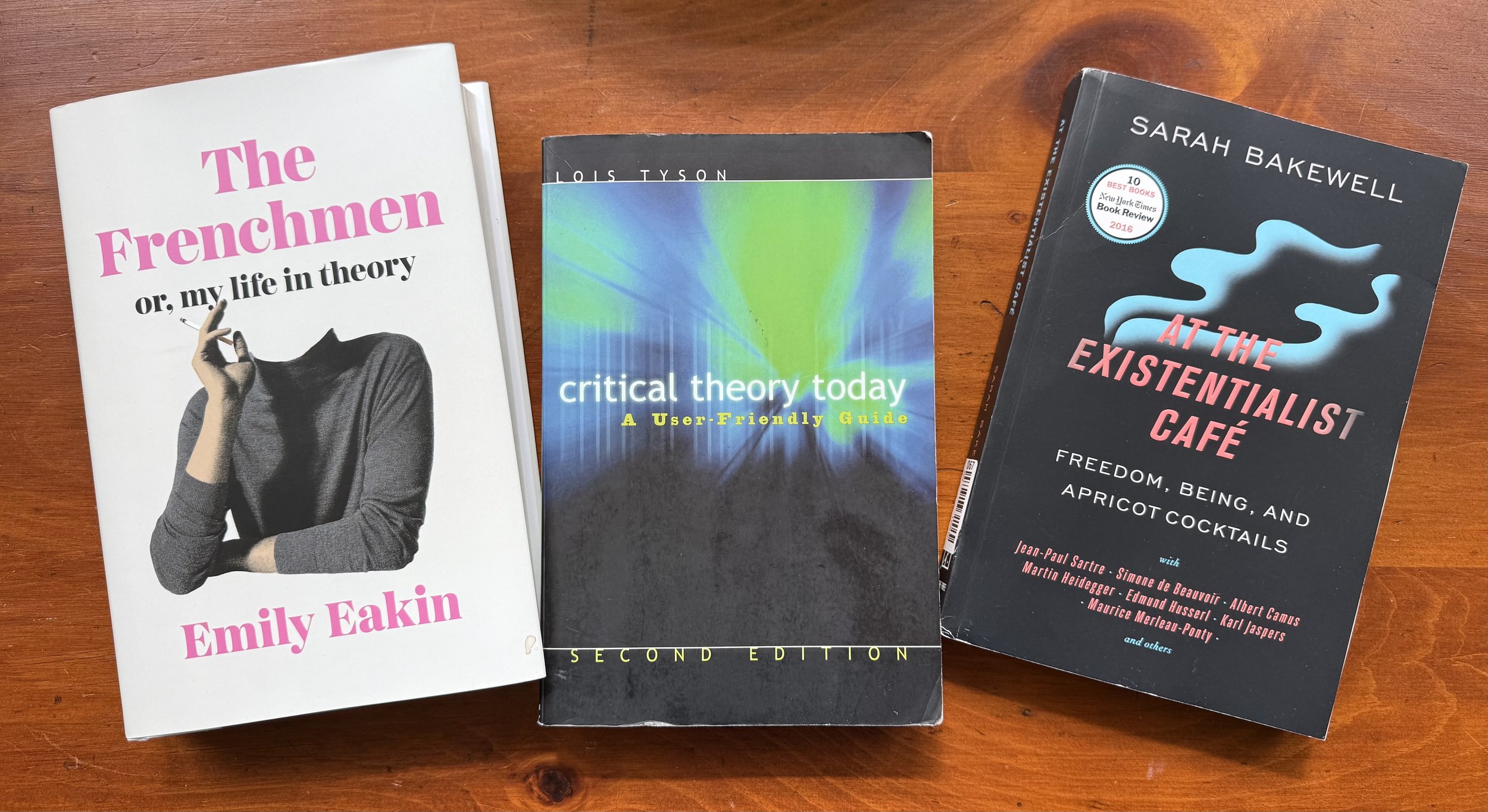
I began to read the excellent book The Frenchmen: or, my life in theory (2026) by Emily Eakin. It is a growing-up story, a Bildungsroman, by a bookish Indiana woman seduced (like Matt Damon’s Odysseus) by the siren-songs of the European literary theorists she encountered at Harvard College in the 1980s. I quickly realized that these writers were responding to the existential thought of the prior generation. Though Eakin discusses Jean-Paul Sartre (1905-1980), I knew the movement was wider and ran earlier than that owl-faced singularity of a man.
Hadn’t someone written a similar book on point? Yes. Eakin graciously acknowledges Sarah Bakewell’s superb At the Existentialist Café: Freedom, Being, and Apricot Cocktails (2016). I called an audible and read both books along with excerpts I have handy of some originals. I was not working with much. From the Salinas Public Library growing up (later the “John Steinbeck Library” after his tourism value rose), I had checked out and skimmed without understanding the collection Irrational Man by William Barrett (1958). At Stanford my professors used something akin to the New Criticism, focused on the text itself (avoiding the heresy of paraphrase) discounting both the author (avoiding the intentional fallacy) and the reader’s response (avoiding the affective fallacy). (I’ve been told that quaint New Criticism has “died out.” Perhaps, but who knows what “unlikely resurrection” some future Easter-tide may bring?) At Yale and later in life I encountered Albert Camus (who denied he was an existentialist) and critics Harold Bloom, Alfred Kazin, M. H. Abrams and Northrop Frye (I am not even sure where they slot).
Thus I had many hectares of Continental ground to make up in my ongoing liberal arts education. Here go my reading notes targeted at “café familiarity” with the lives, works and buzzwords of the leading lights in these movements, if you could call them movements.
EXISTENTIALISTS UND MITLÄUFER
I like definitions and appreciate Bakewell’s brave attempt at one (I’m sure it has been criticized).
Existentialists concern themselves with individual concrete human existence. They consider human existence different from the kind of being others have. Other entities are what they are, but as a human I am whatever I choose to make of myself at every moment. I am free—and therefore I am responsible for everything I do, a dizzying fact which causes an anxiety inseparable from human existence itself. On the other hand, I am only free within situations, which can include factors in my own biology and psychology as well as physical, historical and social variables of the world into which I have been thrown. Despite the limitations, I always want more; I am passionately involved in personal projects of all kinds. Human existence is thus ambiguous: at once boxed in by borders and yet transcendent and exhilarating. An existentialist who is also phenomenological provides no easy rules for dealing with this condition, but instead concentrates on describing lived experience as it presents itself. By describing experience well, he or she hopes to understand the existence and awaken to ways of living more authentic lives.
“I’m stuck in a world I don’t control without an instruction manual.” This feeling goes back to Job and Ecclesiastes, to Augustine and Pascal, and to Fyodor (“‘everything is permitted,’ says Ivan Karamazov”) Dostoevsky. It really picks up with Søren Kierkegaard (1813-1855), the great sound-bite coiner (Concluding Unscientific Postscript, Either/Or, Fear and Trembling, The Sickness Unto Death), who said, “Anxiety is the dizziness of freedom” relieved by the “leap of faith” to God (like Abraham obeying the initial order to sacrifice his son). Friedrich Nietzsche (1844-1900) said the path out is for the Übermensch (Overman) to craft and follow his own values. Not everyone makes that leap or is that superior a beast, blond or otherwise.
Now we head for the cafés of Paris. The rooms in hotels and apartments were not climate-controlled, making the ground-floor eateries the perfect place for firebrands to discuss great ideas. They included the Bec-de-Gaz bar on rue du Montparnasse, and the Flore, Deux Magots and Bar Napoleon on boulevard Saint-Germain and rue Bonaparte near Saint-Germain-des-Prés church on the Rive Gauche. I see online that at least the Deux Magots (“two mandarins”) is still open for tourists and others.
In the winter of 1932, at the Bec-de-Gaz, young Raymond Aron fresh from Berlin told two of his classmates about phenomenology and Edmund Husserl (1859-1938). This professor eschewed the German tradition then led by Ernst Cassirer of parsing Immanuel Kant, Georg Wilhelm Friedrich Hegel and the left-young and right-old Hegelians. He sidelined metaphysics and called on us to describe the phenomena we sense, while engaging in epoché or “bracketing off” of our attitudes, prejudices and biographies. (His teaching took some turns over time.)
Martin Heidegger (1889-1976) is the villain in these books (like John Milton’s Lucifer (remember Animal House?) and George Lucas’s Darth Vader, a more interesting character than the heroes). He disliked biography—he began a long lecture series about Aristotle by saying “He was born, he worked, and he died” and moving on. In his massive Sein und Zeit (Being and Time, 1927), Heidegger made a big deal of breaking with Husserl, asking what it means for a human to be in the world of phenomena—the Dasein (being-there). The two men couldn’t even co-author an Encyclopaedia Brittanica article on phenomenology. He would dig deeply into works to provide his points (some used “to heidegger” as a verb for exegesis). His thought also took turns, including one in fact called “The Turn” (die Kehre). He was a card-carrying Nazi 1935-1945, an affiliation he ascribed to his Dummheit (stupidity). After the war he was declared a mere Mitläufer, a “fellow traveler,” but was unrepentant. When Herbert Marcuse brought up the Holocaust, Heidegger retorted “what about” how East Germans were being treated.
Aron’s classmates were Sartre and Simone de Beauvoir (1908-1986), his long-term but nonexclusive companion and a formidable thinker in her own right. Sartre headed to Germany in 1933 (a chancy thing in itself) to study this new field. A bored weatherman in Alsace in 1940, he promptly became a prisoner of war—but “escaped” when he asked pretty-please for a day-pass to go see an eye-doctor outside the camp, got one (!) and never returned (the fate of that guard is unknown; since Sartre lived openly I take it the record-keeping was poor or he was not considered a prime military asset for the SS to recover). When he arrived in grim occupied Paris, he said he felt freer in the Stalag. He tried hallucinogens for enlightenment (like Aldous Huxley in The Doors of Perception—cue Jim Morrison!) but all he received were weird visions of lobstery creatures.
From that odd complex of experiences came Sartre’s brand of existentialism, unpacked in novels, plays and a massive treatise. Nausea 1938 is the diary of the melancholic Roquentin. The Flies 1943 refers to the insects chasing Orestes away after he avenges the death of his father Agamemnon by killing his mother and her lover, to an uncertain fate outside the protection of Zeus for himself (and by extension for all of us). No Exit is about three condemned people locked in Hell, and since they are dead, it is too late to change anyone’s impressions of oneself; hence L’enfer, c’est les autres (“Hell is other people”). His Being and Nothingness 1943 is obviously a response to Heidegger (a reviewer said it was a 700-page draft for a 300-page book). Key Sartre concepts include: “Man is condemned to be free.” “Existence precedes essence.” “Words are loaded pistols.”
Meanwhile Beauvoir authored The Second Sex (1949). “One is not born, but rather becomes, a woman.” It is a history of humanity as patriarchy, and a life-cycle story of a woman. Recall that French suffrage arrived only in 1944 and married women couldn’t open a bank account until 1965. Girls grow up conditioned not to grab hold of the world, and to avoid breaking their fingernails; they are taught to be positioned in space not to define space. Sex is associated with marriage, but marriage in turn is associated with never-ending housework (as the philosopher Phyllis Diller said, “Cleaning your house while your kids are still growing/Is like shoveling the driveway before it stops snowing”). Both the master and the slave see the world from the standpoint of the master—a woman acts in bad faith by pretending to be an object when she isn’t one. Camus criticized it for making the French male appear ridiculous (hey, if the chaussure fits, wear it). The book radically transformed many women’s lives, especially in the UK and the US (the first English translation watered down the philosophical and lesbian references).
The dynamic duo took controversial political stands. After Hiroshima, Sartre noted, every day humanity wakes up and must decide whether to go on living. They clung to Moscow Communism even as others retreated to a purer Marxism or abandoned it altogether, and even as word spread of the Soviet gulags and mass deaths. (In 1953, the École Normale, France’s élite school, observed a moment of silence for the death of Stalin and inquired to whom condolences might be sent!) They supported the Algerian independence movement even as rebels killed citizens, and he signed a petition that landed other signatories in police custody. Soldiers chanted “Shoot Sartre!” but President General Charles de Gaulle said, “One does not imprison Voltaire.” That’s a pretty good “[stay] out of jail” card.
Sartre wrote Black Orpheus encouraging a “black gaze” at the world (no relation to the Brazilian musical of that name). He contributed a foreword to Frantz Fanon’s The Wretched of the Earth calling for colonial revolutions but neither shying away from nor glorifying violence. Under Sartre’s influence, Richard Wright wrote The Outsider exploring existential themes in the life of a black man deprived of individual agency. (Relations among Richard Wright, Ralph Ellison and James Baldwin were super testy. When Wright wrote an innocuous note to Ellison congratulating him on Invisible Man and inviting him to Paris, Ellison responded, “I am getting a little sick of American Negroes running over [to France] for a few weeks and coming back insisting that it’s a paradise.”)
Despite the morose prose, Sartre had fun. He sang “Old Man River” in clubs like Tabou and L’orientaïs, and conquered the US on speaking tours (“Women swooned,” gushed Time magazine). Postwar Paris loved everything American—jazz, Coca-Cola, and plaid shirts (not turtlenecks yet—for those, see the English Colin Wilson who had a character call clubgoers daddy-o and toots). And when other big thinkers like Aron and Louis Althusser slinked away, Sartre embraced the students in May of 1968.
Interlude: May 68. In late 1967, students at the suburban Nanterre campus protested various things including sex-segregated dorms (a wag in Le Monde said they had a prurient idea of “The Universal Rights of Man”). In May 1968 protests shut down Nanterre, whereupon 20,000 students, teachers and others overran the downtown Sorbonne, establishing camps and barricades for three weeks. The well-known graffiti sprang up (“It is forbidden to forbid!” “Be realistic, demand the impossible!” “Of what use is [the absent and silent] Althusser?” “Under the paving stones, the beach [pick up the rocks for projectiles. and find sand underneath]!”). The police or army intervened. The trade unions picked this moment (why not?) for a general wage strike, shutting down commerce and transport nationwide. 500,000 marched in Paris 20 May. De Gaulle dramatically disappeared for a day then returned (showing his Christ complex!). That disappearance might have strengthened his position as the June elections increased the Gaullist party’s control. The students and workers received mild concessions. Sartre was again in the news as a hero of the protestors (and again in Prague with Charter 77 signed by his acolytes). It was a life in full—his 1980 funeral attracted 50,000.
Other existentialists at one time or another include Raymond Aron and Maurice Marleau-Ponty. Albert Camus denied membership in the club. Norman Mailer ran as the Existential candidate for New York City mayor in 1960, but the campaign got off to a rocky start when he stabbed his wife at the launch party.
For early impacts, look no further than the quest for authenticity (not “phoniness”) in The Catcher in the Rye, Rebel Without a Cause, A bout à souffle (Breathless), The Man in the Grey Flannel Suit, The Lonely Crowd, and The Organization Man. More recently, consider Blade Runner, The Matrix, The Truman Show, Eternal Sunshine of the Spotless Mind, Ex Machina. American Beauty, A Serious Man, and The Tree of Life. Jimmy Webb’s “Wichita Lineman” has been called “the first existential country song.”
Sartre said “death is an outrage … that wipes out my projects.” Beauvoir said immortality would be unbearable. You are here.
THE COMPLEAT REBEL
I separate Albert Camus (1913-1960) in his own category as I think he would want. A pied-noir (a Frenchman born in Algeria, like Althusser and Derrida) and football goalie, he broke from supporting Stalin early. He came to fame with 1942’s The Stranger. We never learn Meursault’s first name, or why with the sun in his eyes he kills the Arab man. “Myth of Sisyphus” 1942: if we decide to keep going rather than end our lives, we must accept the absurdity—“one must imagine Sisyphus happy.” The Plague 1947 is set in Oran amid an epidemic (think the German occupation); some try to flee, some try to make a buck/franc, some try to forget and not see things. Which are you? Camus was opposed to capital punishment, and condemned Algerian rebel terrorism—that could be my mother on that bus. The Rebel 1951: pursue rebellion to set things right, not a revolution that but plants the seeds for future revolutions and violence. Elsewhere before and after his Nobel Prize 1957, he advocated for an international government. (Sartre declined the prize in 1964.) In The Fall 1956, a judge rules on his own case. “the more I accuse myself, the more I have a right to judge you.” I find Camus an impressive man from my brief roundup and long-ago recollection, and need to return to his life and work.
STRUCTURALISM AND BEYOND
By the Seventies, existentialism was said to “have done its job.” Its concepts had wormed their way into thinking everywhere. Something new was in the air. Jean Baudrillard asked in 1977, “Who cares about freedom, bad faith and authenticity today?” Where existentialism focused on the anxiously free individual, the new thinkers denied pure human agency and stressed that we are products of structures, systems, and signs. (Two things can be true at the same time, I say…)
I notice that only Derrida seems comfortable with any label, in his case “deconstructionist.” The others skitter like cockroaches in the light when they are asked if they are structuralists or post-structuralists or postmodernists.
Louis Althusser (1918-1990) was a pipe-smoking political philosophy professor who mentored both Foucault and Derrida, and a “Catholic communist” who saw society in the hands of structures (the state, schools, the media, the family, and the consumer economy). He distinguished the younger Marx (theorist leaning on Feuerbach) from the older Marx (scientist; his preferred period though he confessed he had only closely read volume 1 of Das Kapital). “Interpellation” is a word meaning something like “philosophical creation of a concept or individual.” He praised life in the USSR: “of course” one cannot participate in politics there, but otherwise it is splendid. He called himself a “social anarchist.” He openly and immediately confessed to strangling his wife in 1980, and was confined for mental illness treatment.
I am glad to have even this basic bonehead recap of Althusser. Now I can completely understand the notorious Judith Butler sentence that won first prize in the 1998 Bad Writing Contest:
The move from a structuralist account in which capital is understood to structure social relations in relatively homologous ways to a view of hegemony in which power relations are subject to repetition, convergence, and rearticulation brought the question of temporality into the thinking of structure, and marked a shift from a form of Althusserian theory that takes structural totalities as theoretical objects to one in which the insights into the contingent possibility of structure inaugurate a renewed conception of hegemony as bound up with the contingent sites and strategies of the rearticulation of power.
And now so can you. You’re welcome.
Claude Lévi-Strauss (1908-2009) made one brief anthropological “glamping” trip in the Brazilian rainforest and spent the rest of his time in the library. “Savage and civilized” groups have different structures that respond to the same needs (an initiation ceremony, for example). He ridiculed existentialism’s “illusion of subjectivity,” calling it “shop-girl metaphysics” (I don’t know what that means). He applied to social facts Ferdinand de Sassure’s linguistic theory distinguishing (i) language langue from utterances parole and (ii) signifiers (the letters s, h, e, e, p) from the signified (a sheep). Those facts include gift-exchanges, the incest taboo, and extended kinship. A common theme is that exchanging women between families or tribes facilitates social harmony and prosperity (cue Beauvoir!). His other concepts include the bricoleur (user of found materials), the engineer (maker of new ones), and the trickster (e.g., the raven or coyote in folk tales).
Roland Barthes (1915-1980) proclaimed “The Death of the Author” 1967 and the scourge of consumerism (the Citroën is a modern cathedral, a fetish). Mythologies 1957. “Ideology is what-you-are-doing.” Over time he became suspicious of any fixed rules for symbols—the associations are contingent not permanent (hence an attitude something akin to “post-structuralism”). His S/Z is a close reading of Honoré Balzac’s story Sarrasine, about a man who loved Zabinella: the names should be Sarrazin (z not s, no feminine -e ending) and Sabinella (s not z), indicating a cross-fertilization and fusing akin to The Sorrows of Young Werther. (I had been puzzled by that “S/Z” title in bookstores over the years; mystery solved, sort of.) Either in Barthes’s A Lover’s Discourse: Fragments or in Jeffrey Eugenides’ novel about a literary theory teacher The Marriage Plot is the line “only the first je t’aime has meaning.”
Paul de Man (1919-1983) was a Belgian-born Ivy League professor (Harvard, Cornell, Yale) considered “catnip to women.” He wrote Blindness and Insight but is more known for promoting Foucault and Derrida in the US. His reputation was tarnished by uncovering of his wartime antisemitic writings.
Jacques Lacan (1901-1981) was a psychiatrist and psychoanalyst who diverged from Freudian focus on early sex drives, then made a “return to Freud” after others misinterpreted him. He drew Borromean rings and Möbius strips on the chalkboard in lectures—was he mad himself? In any event, his take was that the child loses some connection to his inner being by transitioning from the “mirror stage” seeing himself to the “imaginary order” seeing family members to the “symbolic order” incorporating language and other signs. The only relevant sexual organ is the phallus; a woman by contrast is “not-all,” pas-toute, “does not exist”—meaning the concept of “woman” is only a negative. In understandably strong reaction to this picture lies later feminist theory (see The Laughing Medusa). He performed a detailed analysis of Aimée (“the beloved”). Gilles Deleuze (1925-1995) and Félix Guattari (1930-1992) responded to Lacan in Anti-Oedipus, launching alternative and contrary psychoanalyses.
THE TWO BIGGIES
Michel Foucault (1926-1984) was a student of Althusser and Lacan who had self-harm episodes early on. He candidly said he did “intellectual things that would attract beautiful boys.” Late in life he was known for his shaved head, turtleneck, and appearances at political protests. He said only “half-wits” would call him a “structuralist,” calling himself instead a “critic of authority.”
For Foucault, authority over individuals resides in the power exercised by systems (schools, prisons, asylums, politics). When an authority says something is “settled knowledge,” that is but a veiled means of control. Madness & Civilization 1961: the sanity/madness distinction is a subjective edict, and an asylum is a prison. Order of Things 1966:“Crime is a coup d’etat from below.” Discipline and Punish 1975, History of Sex 1976. He espoused a theory of epistemes (cultural unconscious events). He engaged in close readings of art and literature of all eras. “To speak of madness one must have the heart of a poet.”
Jacques Derrida (1930-2004) was a student of Althusser junior to Foucault. He submitted a paper to Althusser who couldn’t understand it, so gave it to Foucault; Foucault said he also couldn’t understand it, but the paper was either an “F” or an “A+.”
Derrida’s writing (Speech of Phenomena, Of Grammatology) is maddeningly verbose and elliptical; a Heidegger piece was preceded by his foreword four times as long. Sometimes he writes something and then intentionally but legibly crosses it out. Other times he makes puns or ambiguities by adding cute parentheses like “(de)composition.” To what school did Derrida belong, you ask? “Needless to say, one more time, deconstruction, if there is such a thing, takes place in the experience of the impossible.”
“There is no outside-text” (Il n’y a pas de hors-texte). (Critics would misquote him as “there is nothing outside the text” and then attack that.) He coined the term différance (a portmanteau of differ (among concepts) and defer (in time), which he used instead of or in response to Heidegger’s Destruktion). Maybe it is clearer in French.
THE SHARPER CRITIQUES
The alternative views of mental illness (see R. D. Laing and Thomas Szasz) led to de-institutionalization of many patients and are said to have contributed to the homeless problem. Jürgen Habermas attacked Foucault, saying he needs to wield the Enlightenment values that he assaults as power plays. Sure enough, now Foucault is cited by the right wing, e.g., against COVID restrictions.
Theory mainly is found in literature departments. The philosophy departments are even more critical. Rudolf Carnap ridiculed Heidegger’s “the nothing itself noths” (das Nichts selbst nichtet). Theory is a “farce,” but a “farce with consequences.” “Derrida is gloriously bonkers.” “Not even interestingly bad.” “Derrida is difficult to summarize because it’s nonsense.” Derrida is appalling, pathetic, a failure, amoral, a different species—“well, maybe I missed something: could be, but suspicions remain, as noted” (Noam Chomsky). See The Eagles, Victim of Love (“I could be wrong, but I’m not.”).
Tony Judt (who studied in Paris but rejected theory) speculated that Descartes’ rejection of doubt led “the French” to think in such absolute terms. That observation takes me back to Kant’s categories and to the beginning of this article, in the time of Ernst Cassirer. That seems to be the point of departure in the lines of modern thought.
POMO NOGO
I don’t know how much time to spend on postmodernism. Jean-François Lyotard says its essence is “incredulity toward metanarratives.” Jean Baudrillard may or may not be part of the pack (Forget Foucault 1977; Simulacra and Simulation 1981, a basis for The Matrix). Don’t get me wrong, “postmodern” is a great adjective to describe uses of fragments, mosaics, time-jumps and self-referencing in art, music, literature, television shows, and movies. The works called “postmodern” in these contexts are playful and camp and I like many of them. Some favorites include Don DeLillo’s Underworld, Quentin Tarantino’s Pulp Fiction, The Beatles’ A Day in the Life, … I could go on.
As a theory to analyze literature, though? Fuggeddaboutit. By conveying that everything including truth is up for grabs, we invite nihilism. Even a good idea gets taken too far. Luce Irigaray makes a perfectly valid point that a scientist’s personal identity may affect what investigations are made and how they are made—look at how drug tests are mostly performed on men so the impact on women is understudied. But then she concludes, in a refereed scholarly publication, “By privileging the speed of light over other speeds that are vitally necessary to us, E=mc^2 is a sexed equation.” From here it is not surprising that Alan Sokal could get a paper refereed and published by the Social Text journal saying π (3.14…) and Newton’s gravitational constant G (6.67…), “formerly thought to be constant and universal, are now perceived in their ineluctable historicity.”
“THAT’S THE PROBLEM WITH ART, YOU CAN’T DRINK IT” (P.D.Q. Bach)
Bakewell and Eakin do their best to convince us that our selection of existentialism or any particular later theory can be helpful, but I reserve judgment. I still like analyzing the text, learning about the author, gauging my own personal reactions, and sampling from many different analytic methods.
Lois Tyson produces a useful compilation, Literary Theory Today: A User-Friendly Guide (2d ed. 2006), explaining eleven different bases on which to critique a work—in her main case, F. Scott Fitzgerald’s The Great Gatsby (she also frequently applies them to Toni Morrison’s The Bluest Eye and Mary Shelley’s Frankenstein). Not surprisingly, I liked the “now obsolete” New Criticism application the best. It called out features I hadn’t noticed on the Aristotelian unities of time, place and action; paradoxes and comparisons; all kinds of literal, dramatic and situational irony; studied ambiguity; buildup and release of tension; and especially narratology (the story (plot), the narrative (deployed order of scenes), and the narrator). The ten others (psychoanalytic, Marxist, feminist, reader-response, structuralist, deconstructive (the worst), cultural, LGBTQ+, African American and postcolonial) might have virtues in some contexts—but not many here.
For example, the postcolonial critique of The Great Gatsby treats almost every reference to ethnicity as a negative “othering,” especially of people of color but even of Nick Carraway’s “Finn” housecleaner and to some extent the “Greek” guy who runs the place next to George Wilson’s garage. When Myrtle Wilson, uncomfortable in the fancy Manhattan party, acts in an “affected” manner, the criticism says she “behaves as a colonial subject.” I suppose Fitzgerald could have avoided the “subaltern’s” disappointed gaze by never describing at all the characteristics of his characters. But that’s why they’re called “characteristics”!
Tyson confesses in her first chapter that to the naïve newcomer, this kind of theory writing “doesn’t seem to connect with our love of literature.” I am not afraid to say I don’t think the rest of the well-written book ever convinces me otherwise. I’m happy to be pursuing my evergreen education here in ungraded retirement, not in any form of graded classroom.