Simone & Hannah: Thelma & Louise II?
Weil, Arendt, and what they might have thought about artificial intelligence.
Rob James
July 26, 2026
I have no idea to this day what those two [European] ladies were singing about.
—Ellis (“Red”) Redding (Morgan Freeman), in The Shawshank Redemption
I was reading a New York Review of Books interview, in which the inevitable question of influence arose. It was posed to Meghan O’Gieblyn, author of the fine article “We Did Our Best!” where she asks the haunting question: As between the human and AI, which is the mother and which is the child?
Who influenced her? O’Gieblyn reported being intimately affected by Simone Weil and Hannah Arendt, and made fascinating observations on what the two of them might have thought of artificial intelligence. See the Appendix to this post, entitled “Appendix” for easy reference.
Arendt and Weil, Weil and Arendt. As is usual for me with highfalutin intellectual name-dropping, I reacted with the open-mouthed face of Michael Banks in Mary Poppins:

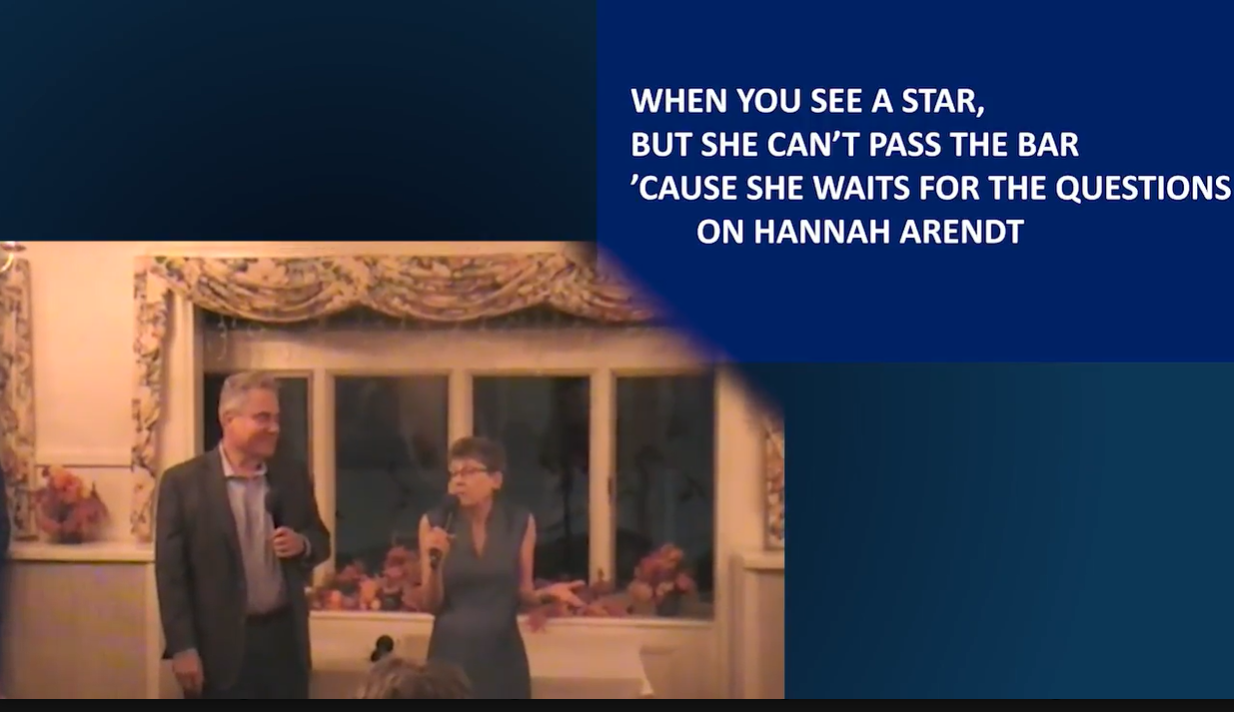
As to Arendt, I had read Eichmann in Jerusalem in college, and I recalled the belated revelation that she had dallied with the tarnished Martin Heidegger. Otherwise I knew her only from the punchline of my friend Ron Weich at the comedy show I directed, the 1982 Yale Law Revue. We Yalies poked fun at our law school’s notoriously unconventional curriculum. Here is Ron with Mary Benjamin Trevor in our 2023 reunion reprise, sung to the tune of the title song of “Guys and Dolls”:
I knew even less about Weil. I thought she died young and was sorta Christian, sorta not-Christian. Those cumulo-nimbus clouds of vague impressions were all I had.
That magazine discussion of Weil, Arendt and technology intrigued me. After all, I am beginning to grapple with what to make of AI. More generally, here loomed two important thinkers about whom I knew little and knew I should know more. This was my opportunity for one of my patent-not-pending amateur Compensatory Culture Dives! So I delved a little deeper into the lives, works and essence of these courageous women.
Simone Weil
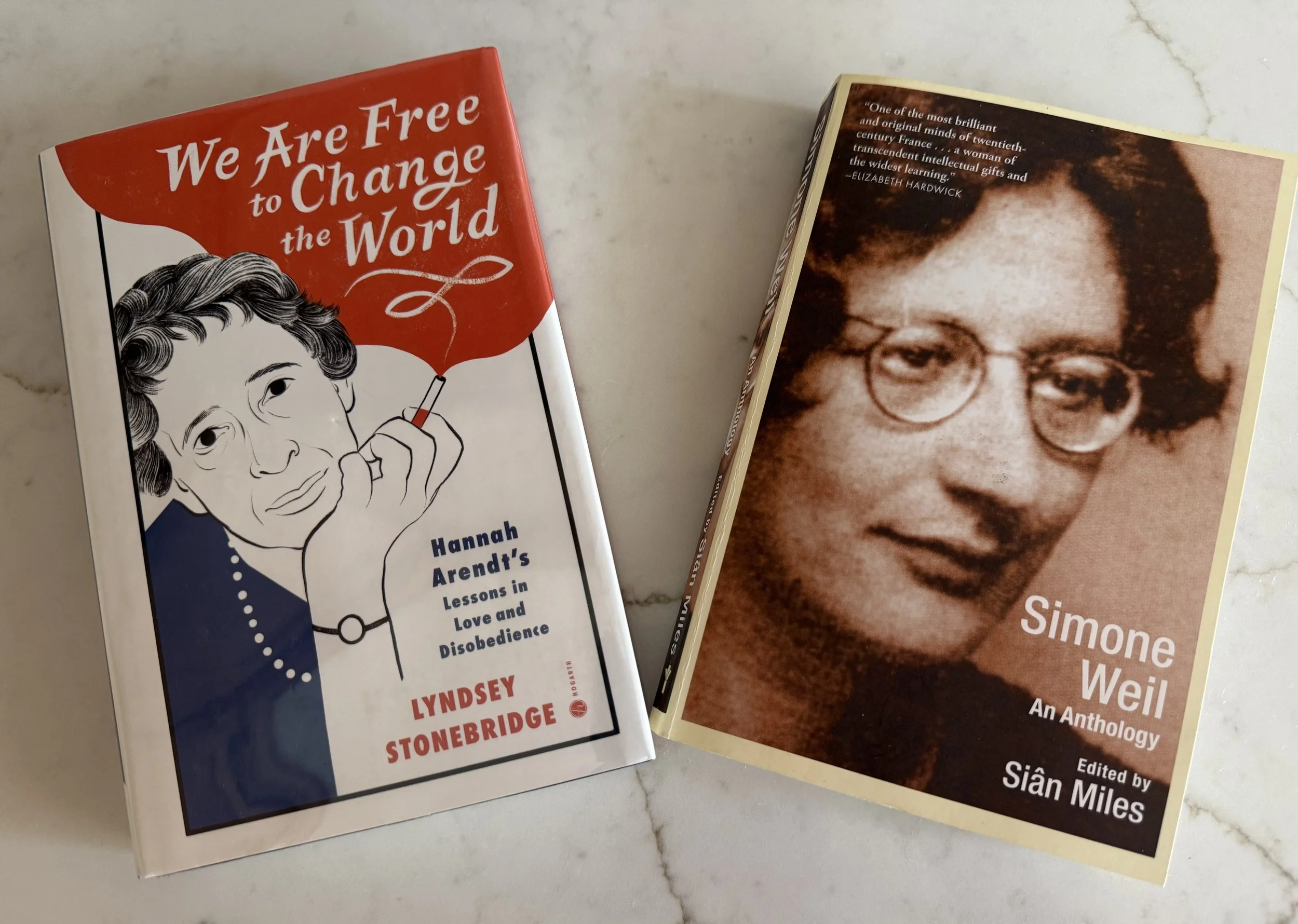
Weil (1909-1943) has been sized up as “philosopher, sociologist, mystic, teacher, and political activist” (Siân Miles, ed., Simone Weil: An Anthology (1986)), to which Wikipedia correctly adds “labourer.” Remarkably, I think those descriptions cumulatively undersell her reach.
Raised in a secular Jewish Parisian family, from birth she was positively dripping with empathy. She donated her sugar and chocolate ration to World War I soldiers as a child, she declared for Bolshevism at age ten, she joined trade-union and general-strike movements as a teen. She worked for a while as a gen-yoo-ine factory and vineyard proletarian. She was a Renault auto assembler and a power-press operator who didn’t hit her productivity quotas, like Charlie Chaplin or Lucy Ricardo. She took those jobs because she felt that “truth should be experienced.” That zinger might have been a snide-shot at the café-dining, Gauloises-smoking, boulevardiere Simone de Beauvoir, a school contemporary. (De Beauvoir said it is more important to discover the reason for existence than to be happy, to which Weil replied something like, “Well, it’s clear you’ve never been hungry.” Me-ouch!)
Weil was a well-meaning but impractical klutz. She tried to help an organized company of anarchists (!!!!!) in the Spanish Civil War, she really did. Alas, she had such dangerously bad vision that her own troops had to restrain her from aiming a machine gun. She scarred her foot with spilled cooking oil, and her unkempt clothes bore negligent cigarette-burns. She improbably volunteered to impersonate a Spaniard never having lived there.
Later, trying to aid the exiled Free French in London, she spilled a sheaf of top-secret papers on the public sidewalk. She proposed that a “front-line nursing squad” be inserted at the Western Front. The purity of these saintly unarmed women, she argued, would inspire the Allies and Résistance and shame the SS and Wehrmacht.
General Charles de Gaulle called her something like “mad,” crazy, loco, wacko, twisted. (Like us, the French, bless them, have so many words for the condition—fou, insensé, démente, insane …) I believe there is a case to be made for that diagnosis.
I was right, she was deeply impressed by the primitive Christianity of the Gospels and the faithful, having experienced the miraculous thrice: watching a Portuguese patron-saint parade, hearing Benedictine plainchant, and reading the beautiful George Herbert metaphysical poem “Love.” She called it “the religion of slaves, [herself a slave] among others.” (Nietzsche would have said “yup”!) But she didn’t care for Christianity under Paul, the Roman Empire, or the Catholic Church. She admired the mystical in other faiths, as with the purity of motive and action in times of strife emphasized in the Bhagavad-Gita. She was not a syncretist: each tradition should be grokked on its own terms, not schmushed together kumbaya.
She gravitated from socialism to a rather unsystematic philosophy (pace, Rob, she died so young and in extremis; give her a break). She expressed several grandiose conceptions using words with highly idiosyncratic meanings. Forgive me if I bungle ‘em.
Kenosis or absence is essentially a “hole in the soul,” an emptiness left where God is not. It is to be relieved by moving from “gravity” to grace. The void in the cosmos leads to a theodicy, her explanation of (or consolation for) why there is evil and pain.
Malheur or affliction arises from a sense of one’s isolation and worthlessness. That condition intensifies in industrial society. After visiting a mine where a man operated a pneumatic drill, she recorded with disappointment that he “forms a single body with the machine, [is] added to the machine like a supplementary gear.” Her impression bears on how she might appraise artificial intelligence.
Décréation is the renunciation she urged, the yielding up of power and of one’s “personality” beyond the mere “I” or “ego.” I stare without understanding at the totally baffling words of Weil’s philosopher-friend Gustave Thibon: “In the great volume of the universe, as she read it, her ego was like a word which she had succeeded, perhaps, in erasing, but it was still underlined.”
(Postscript: After writing this post, I read that years later, the deconstructionist Jacques Derrida would maddeningly write a passage and leave it in print while striking through it but leaving the words quite legible. Perhaps that is what Thibon had in mind.)
Attention is a false friend of a term—it doesn’t mean what it does in English. It is something like “suspending one’s thought, leaving one receptive, detached, and ready to be penetrated by the object,” whether another person, the world, love, beauty, or God. This essentially passive virtue is juxtaposed with the affirmative Will. Hmmm.
Rootedness, in a community or a society, is thwarted by the pursuit of money, by absentee Kapital, and by colonialism. Weil seems to have had an unnuanced idea of the material world. She shares that deficit with many communists, socialists, anarchists, and anti-capitalists (dare I add “2026-vintage American democratic socialists”? I’ll stop).
I don’t think she had a coherent picture of the economy in which she lived. Capitalism has serious faults, I know, as I have stressed elsewhere. But how did she think those ingenious machines she operated and imported materials she processed in the Renault factory got there? Did she even wonder why individuals and groups without coordination or compulsion do something, anything—as Milton Friedman memorably illustrated, even invent and make a freaking pencil? (For a soothing ASMR-worthy example, see This is How the Iconic Blackwing Pencil is Made.)
Metaxy adapted from Plato is something that connects yet divides you and me. A homely parallel is the ambiguous word “cleave” (unite and/or divide), or (my example, not Weil’s!) the “sweetest little word” and (die süsste Wortlein und) inside Wagner’s Tristan und Isolde. The words “I love you” can be either commonplace or extraordinary, Weil said, according to the depth of being of the man or woman from whom they proceed and to whom they are directed. (Stop thinking so much, I say; say Je t’aime anywhere anyway any time.)
Many others. I like her contention that Force is the real hero of the Iliad, the motivating spirit of Greek and Trojan alike. (Arendt wrote something similar, admiring Homer for singing the praises of Hector not just Achilles.) The title of Weil’s posthumous Waiting for God (not Godot!) captures her philosophy pretty well.
Weil may have died in part of voluntary malnutrition, electing solidarity with those starving elsewhere. Albert Camus hailed her as “the only great spirit of our times.” T. S. Eliot said she possessed “a great soul and brilliant mind” with “a kind of genius akin to that of the saints.” Less complimentary appellations, from cruel schoolchildren and sophisticated critics, were “The Martian,” “The Red Virgin,” “Saint Joan of the Workshops,” and “Donna Quixote.”
My tentative view, subject as always to revision, is that Simone Weil was an eccentric. She should not, no way, no never be allowed near a crate of hand grenades. But she was a profound eccentric.
Hannah Arendt
Arendt (1906-1975) was raised in a secular, assimilated Jewish German family. At 18 she began a three- or four-year affair with her prof, the 35-year-old, married-with-two-kids Martin Heidegger (1889-1976). (They toggled light switches to signal the coast was clear for their trysts.) By this point Heidegger had split from Edmund Husserl (1859-1938) and was developing his big-deal doorstop Being and Time (Sein und Zeit) distinguishing human being in the world (Dasein) from the rest of existence. Heidegger was a Nazi party member from 1935 to 1945. The affair became public knowledge only after Arendt’s death. See Elisabeth Young-Bruehl, Hannah Arendt: For Love of the World (1982).
Arendt left Germany in 1933 after a brief imprisonment by the Gestapo for researching antisemitism (!). (She escaped on the German-Czechoslovak border and I mean literally “on” the border—she entered the front door of a house in Germany in the Erzgebirge Mountains in daylight and at night slipped out to back door into Czechoslovakia!) Arriving vulnerably without documentation in France, she eventually underwent an “enemy alien” internment (really a Jewish internment). The experience jolted her out of assimilation—“if one is attacked as a Jew, one must defend oneself as a Jew.” She escaped in 1941 and landed in the United States, where she embarked on an itinerant academic career.
She adopted the Max Weber term pariah as a badge of pride, as did her thesis adviser Karl Jaspers (1883-1969). She resented Frankfurt School ringleaders Max Horkheimer and Theodor Adorno for attacking Heidegger. Her own relation to her former lover was complicated, sometimes criticizing him but other times chalking up his Nazi affiliation to “childish dishonesty.”
Arendt’s political philosophy emphasized active citizenship. Like Weil she was a fan of early Christianity, in Arendt’s case St. Augustine of all people, “the most powerfully human of saints” (see Claudia Roth Pierpont, Passionate Minds: Women Rewriting the World (2000) (profiling Arendt and the novelist Mary McCarthy, who published her friend’s Life of the Mind posthumously)). Arendt parsed and subdivided love as desire, love of the Creator, love of neighbor, and most broadly “love of the world” (amor mundi).
The Origins of Totalitarianism (1951) lumped Nazism and Stalinism together, to the dismay of contemporary leftists. (Weil had also observed back in the Thirties that the German and Soviet authoritarians were peas in a pod.) Arendt treated the Holocaust and other racial horrors as integral consequences of these movements, not wartime reactions. She warned that isolation of masses, misinformation and propaganda collectively lead to obedience and tyranny. Those are alarums for our political and technological world today. As Arendt asked, “Why did it happen? How could it have happened?” See Lyndsey Stonebridge, We Are Free to Change the World: Hannah Arendt’s Lessons in Love and Disobedience (2024), written in and for a new era of global totalitarianism.
The Human Condition (1958) records how rare political freedom has been. Where it exists, it must be fought for and defended. Arendt doubted there are universal natural rights—the rights you have are those recognized by your fellow men. (Weil similarly held that there are no natural rights, only natural obligations.)
Despite writing about dark times, Arendt had a positive vision of the possibility of a brighter, common world. She spoke of an evergreen “natality”: “Men, though they must die, are not born in order to die but in order to begin.”
Her reputation took a turn (very different from Heidegger’s supposed philosophical “turn,” or Kehre) when her attention turned to the postwar Middle East. She opposed a purely Jewish state and only reluctantly supported a dual-state system (I guess she preferred a more cosmopolitan Levantine state?). She was greeted warmly in Israel when she arrived to cover the Adolf Eichmann trial for the New Yorker. But boy howdy was she was attacked upon release of her reportage.
Eichmann in Jerusalem: A Report on the Banality of Evil (1963) criticized practically everyone (the Nazi brass seem to get lost in the shuffle). The opening even faults the courthouse translation system as prejudicial to German speakers. She faulted the leaders of the Jewish councils, the Judenräte, which she said facilitated and augmented the terror. (According to Raul Hilberg’s contemporaneous The Destruction of the European Jews (1961), when the Warsaw Ghetto Uprising began, among the first assaulted were rabbis on the local council.) Astonishingly, she faulted the victims themselves, as part of “the fact of Jewish collaboration.”
Arendt faulted the Israeli government’s methods in extracting Eichmann from Argentina. She faulted the Israeli marriage laws, which she compared to the Nuremberg Laws. And she especially faulted the prosecutors, describing various officials as “Galician” or “Sephardic.” Great move, Hannah, to use racially loaded language, even with evidently intended irony.
These lawyers, she said, inflated the accusations and facts to make the defendant out to be both more and less than he really was. (Later historians including Barbara Tuchman have faulted Arendt in turn, for not seeing that Eichmann was deeply engaged in policy.)
Eichmann protested that he was only doing his duty by following orders to send others to their deaths. Arendt excoriated him not so much for being an instigator as for his willful refusal to think at all, for “his inability to think, namely to think from the standpoint of somebody else,” for being a “walking disaster.” His case proves “the lesson of the fearsome, word-and-thought-defying banality of evil” that could take hold in anyone in any totalitarian state, in any bureaucracy, and in any situation in which we cede our judgment to someone else or something else.
Eichmann in Jerusalem is a disturbing read for all kinds of reasons. I love Arendt’s conclusion that others have adopted as her motto of sorts: “No man has, according to Kant, the right to obey.” My amateur’s understanding of that is you can’t take the easy way out by simply going along and getting along; you must forever exercise judgment. (Note her “bei Kant” hedge, though. What about “bei Arendt”?) Again, there are lessons here for dealing with AI.
I admire Arendt’s taking her convictions wherever they led her, no matter the reactions and controversies. “There are no dangerous thoughts, thinking itself is dangerous” (1971). I do think she could have been more empathetic and circumspect with respect to her objections to the Little Rock, Arkansas school desegregation (on which she sparred with Ralph Ellison, who called her aloof, distant dissent “Olympian”) and of course with respect to the Holocaust.
###
I’m not sure my amateur roundup sufficiently lassoed the thought of either woman by herself, let alone both in virtual conversation with one another. Their unease with industrial organizations, and with any attempt to abdicate moral judgment to others, whether man or machine, shines through. The Shawshank Redemption scene from which my epigram comes may best capture my state of mind—“stag” admiration unescorted by comprehension.
Neither Arendt nor Weil spends a lot of time discussing gender. It nonetheless is fair game to mine their work and lives for insights. Weil had a complicated relationship with her own sexuality, so the biographical if not literary material is there for the picking! See, e.g., Sophie Bourgeaut, “Beyond the Saint and the Red Virgin: Simone Weil as Feminist Theorist of Care,” Frontiers: A Journal of Women’s Studies v. 35, no. 1 (2014).
On the other hand, Arendt repeatedly and unambiguously excluded consideration of gender from her examination of the public sphere. She deliberately elected not to factor it expressly into her political philosophy. According to Young-Bruehl, she (understandably!) disliked the New York Times headline about her Princeton gig, “FACULTY ADDS WOMAN.” It is more difficult to cull relevant material from her writing, but folks try—or instead they try to derive meaning or intention from its absence!
I like the image of Hannah and Simone hijacking a 1966 turquoise Thunderbird convertible (with or without a Brad Pitt type) and driving off on a Thelma & Louise-sequel road trip.
Only I wouldn’t let Simone get anywhere close to the steering wheel.
###
APPENDIX: Arendt, Weil, and Artificial Intelligence
From Meghan O’Gieblyn (NYRB email July 11, 2026). (O’Gieblyn also wrote the books God Human Animal Machine and Will and Attention, weaving thoughts on religion, technology and philosophy.)
I’m always returning to Hannah Arendt and Simone Weil, two philosophers who warned about the dangers of cognitive and moral atrophy. It’s remarkable to me how prescient, and enduringly relevant, their writing on technology is, given that it was produced during the middle of the last century. Both were concerned with the automation of thought, the temptation to outsource reasoning to opaque systems—be they ideological, mathematical, or technological—and the possibility that we might arrive at a position of total dependence on processes we don’t really understand.
In The Human Condition, Arendt envisioned a future in which our actions become too complex for our brains to understand, “so that from now on we would indeed need artificial machines to do our thinking and speaking.” In one of Weil’s political essays from the 1930s, she imagines a civilization where “all human activity … was subjected right down to matters of detail to an altogether mathematical strictness, and that without a single human being understanding anything at all about what he was doing.”
Both of them pointed out that the abdication of thinking was not unique to our relationship with technology: it’s something we do naturally any time we defer to dogma, common wisdom, or facile clichés. It’s this observation that has most inflected my technological criticism. It’s not that AI is an entirely novel risk. It simply accelerates our tendency to defer to formulaic templates in order to avoid the difficult work of thinking.